
Anglican Council of Indigenous Peoples’
Seventh National Sacred Circle
August 5-12, 2012 | Pinawa, Man.
The Seventh Anglican Indigenous Sacred Circle took place August 5–12, 2012 at the Wilderness Edge Retreat and Conference Center in Pinawa, Man., bringing together more than 200 Indigenous Anglicans from across the country for prayer, worship and discernment. It was a time for us to reflect on our spiritual life and our shared history, and to shape a path forward for Indigenous ministry and self-determination within the Anglican Church of Canada. Our discussions included governance and representation, with strong support from Manitoba for proposals to establish an Indigenous bishop for the region.
2012 Sacred Circle blog
Day 6 daily reflection (PDF)
- Primate’s closing homily: On Aug. 11, the Primate of the Anglican Church of Canada, Archbishop Fred Hiltz, delivered a moving homily as part of the closing Eucharist in the main tent of Sacred Circle. The Primate and other General Synod staff have served as partners throughout Sacred Circle. (video)
- New structures for Indigenous minstry: Sacred Circle membered approved Canon 22 on national Indigenous ministry. This proposed church law describes formal structures for electing the National Indigenous Anglican Bishop, the membership of the Anglican Council of Indigenous Peoples, and the membership of Sacred Circle. It will be considered at the national meeting of General Synod 2013. (video)
- Talking about suicide (video)
Cynthia Patterson, coordinator for the Anglican Suicide Prevention Program, spoke about the crisis of suicides in many communities. She encouraged people to talk about the problem instead of avoiding it.
“They say it brings you down when you talk about suicide but I really liked what they did today,” said one memory keeper.
Another memory keeper said that this problem was not affecting all communities so some people couldn’t personally identify with the tragedies. However, all people were moved to hear of other members of their Indigenous family suffering—especially in the Arctic and Nunavut, where rates of suicide are among the highest in the world.
The presentation was followed by a powerful healing service, led by the bishops.
“It felt like a shared commodity under the tent,” said a memory keeper. “It was about people who had lost people, people who were dying, and everybody sharing in the healing prayer.”
- Indigenous military chaplains: Sacred Circle heard a presentation on Indigenous Peoples in the military by Major the Rev. Catherine Askew and Vice President Victor C. Flett C.O., Canadian Aboriginal Veterans and Serving Members Association of Canada. (video)
- Time for rest
This afternoon, Sacred Circle members took a break from their work. Some people from remote communities went shopping at Walmart. Others travelled out to see petroforms or walked down to the river for canoeing.
A group of young people (and the young at heart) went body surfing at the Pinawa Dam. Wearing helmets and life jackets they braved the waterfalls, and were sometimes submerged underwater for several long seconds. It was a powerful exercise in facing fears and taking risks, said one member.
“The break was a real treat to refresh our spirits,” said another memory keeper (who stayed on land). “Maybe next time we could do this mid-week.”
- Indigenous strengths: Today the talking circles considered the question What are our strengths as Indigenous Peoples? and a long list emerged, including: our oneness with the earth (“It’s so close it’s like a phone line!”), our young people, our resiliency, our laughter, our dreams, our ability to forgive and the ways we bring traditional culture into the Church.
Day 5 daily reflection (PDF)
- Sisters in Spirit campaign: The Rev. Barb Shoomski talks about the thousands of Indigenous women who are suffering in violent situations and those who have gone missing. She is part of the Sisters in Spirit campaign that has been raising awareness about this problem since 2004. (video)
- Presentation by B.C. members: Members of the Nisga’a Nation lead a presentation to the Sacred Circle, accompanied by other delegates from British Columbia and the National Indigenous Anglican Bishop, Mark MacDonald. This short video includes traditional drumming and a hymn sung a cappella. (video)
- Malcolm Naea Chun, an Episcopalian partner from Hawaii and a member of the Anglican Indigenous Network, reflects on his long-time partnership with Sacred Circle. He also encourages members to move towards peaceful reconciliation. (video)
- Youth impress
Members were impressed by a video presentation by the young people. Their film integrated the seven sacred teachings and creative answers to the talking circle questions. They also performed an original song that had been written and arranged by several group members.
“I am so proud,” said one memory keeper. “It’s another sign of maturity for our people. They’re growing and feeling confident in their identity.”
Memory keepers celebrated the fact that this Sacred Circle is feeling more like a family, with more children and teenagers here than before.
- Partners provide recap: Memory keepers were moved by the presentation from Malcolm Naea Chun, former secretary general of the Anglican Indigenous Network and a long-time Sacred Circle partner. Mr. Chun’s call to peaceful reconciliation between Indigenous and non-Indigenous peoples struck a chord. Mr. Chun also made a powerful observation that it is hard to see your progress when you are in a gathering, but as a partner from away (a Hawaiian Episcopalian) he has the privilege of recapping the amazing progress he’s seen among Indigenous Anglicans in Canada.
- Joys and challenges of talking circles
Memory keepers shared how working in a talking circle can be a good, but sometimes challenging experience.
One memory keeper shared how a talking circle overcame divisions of language, education, and geography by spending more time listening to certain members of the group. This group has experienced a transformation.
Another memory keeper said it was often hard to talk about divisive topics in a circle—especially if your opinion is in the minority.
All memory keepers agreed that it was important to maintain trust within the talking circles.
- Self-determination in Manitoba
Today Sacred Circle members celebrated another step towards a self-determining, Indigenous church. A large group from Manitoba presented a proposal for an Indigenous bishop who will serve Indigenous communities within the civil province of Manitoba, which has three Anglican dioceses: Keewatin, Brandon, and Rupert’s Land.
“The presentation moved me to tears,” said one memory keeper, “because we fulfilled the dreams of our elders.”
Members also celebrated the election of Adam Halkett, who was elected July 28 as the first Indigenous diocesan bishop in the Diocese of Saskatchewan. Bishop-elect Halkett will serve alongside the current diocesan bishop, the Right Rev. Michael Hawkins, with a mandate to serve Indigenous congregations within the diocese.
Memory keepers noted that while some communities are making great steps towards self-determination, others are struggling.
Tonight members of the Nisga’a Nation spoke about many challenges in their diocese and their community’s need for spiritual renewal.
Day 4 daily reflection (PDF)
- Checking in with members: On Aug. 9, Anglican Video interviewed Sacred Circle members to get their impressions of the meeting so far. People interviewed include the Rev. Iola Metuq, the Rev. Lisa Brant Francis, and the Ven. Dr. Larry Beardy. (video)
- Young filmmakers: The young adults were busy all day, running around with cameras, interviewing people, uploading files, and working away on their computers. They are making a movie that (Lord willing!) should be ready on Thursday afternoon. It will capture their responses to the questions that the talking circles have been working through. There will be songs, art, and lots of insight. “I think the youth will lead us to a new church,” said one memory keeper. “They will build alongside our old church, not abandon it.”
- National Indigenous governance
Today members heard about plans to establish formal structures for national Indigenous Anglican governance in national church law, Canon 22. The changes would include the process for electing the National Indigenous Anglican Bishop, the membership of the Anglican Council of Indigenous Peoples and the membership of Sacred Circle.
Members heard presentations from members of the national Governance Working Group. Memory keepers noted that the historical overview by Bishop Sue Moxley of Nova Scotia and Prince Edward Island, was very helpful.
The topic of national governance inspired many comments from the floor of Sacred Circle. Some were eager to move forward and have these Indigenous bodies established in the national church’s laws. Other members were concerned about moving too quickly. They said there was not adequate communication or consultation around this subject.
The memory keepers, both former members of ACIP, said they know how hard it is for leaders to shape this kind of document. Being on ACIP requires commitment and sacrifice.
“Canon 22 is a very important and visionary document in front of us,” said one memory keeper. “We need it in our churches, our government bodies, our National Indigenous Anglican Bishop, our youth—we all need it.”
Sacred Circle members will return to these questions later in the week.
- Amazing Grace: Sacred Circle members from the Eastern Arctic sing their own version of Amazing Grace. Bishop Andrew Atagotaaluk of the Arctic plays the accordion with National Indigenous Anglican Bishop Mark MacDonald on guitar. (video)
Day 3 daily reflection (PDF)
- Adele Finney, Executive Director of the Primate’s World Relief and Development Fund, offers greetings from PWRDF. She explains how PWRDF has been in partnership with the Anglican Council of Indigenous Peoples and what the plans are for moving forward together. (video)
- Ted Quewezance of the National Residential School Survivors Society shares his family story with Sacred Circle. He talked about how residential schools affected five generations of his family, and how they have worked hard to rebuild their sense of identity. (video)
- National Bishop Susan Johnson of the Evangelical Lutheran Church in Canada offers greetings to Sacred Circle from her home church. She also speaks about the need for spiritual renewal within all churches. (video)
- How healed are we?
One memory keeper noticed that healing has been an important theme, especially after Bishop Andrew Atagotaaluk’s comment yesterday—that leaders need to be healed before they move on to mission.
This statement inspired lots of questions in the talking circles:
- How do we deal with leaders who are half-healed or not healed at all?
- Clergy often bear a lot of grief, emotion, and stress—especially in isolated communities. How are we supporting them?
- What role does the Truth and Reconciliation Commission play in our healing? What can we realistically expect?
- Residential school wounds still with us
Many were touched by the keynote from Ted Quewezance of the National Residential School Survivors Society. He shared how the residential schools affected five generations of his family and what they were doing to rebuild.
Earlier today, in several talking circles people felt led to talk about their experiences in residential schools.
For some Sacred Circle members, this sharing was a surprise because they thought that people had moved on from these experiences.
For others, it brought up personal memories of feeling humiliated by their heritage, for example, if they were punished for speaking their language in school.
“It was difficult for me to hear others’ stories even though I’ve been doing a lot of work on myself,” said one memory keeper.
“It was difficult to feel the pain that these ladies were feeling. I didn’t know what to do, but they asked us come and pray for them, and we just prayed.”
- Questions to build
Today the talking circles got into some big questions: “What makes an effective church?”, “What does an educational model that works for Indigenous ministry look like? How are we equipping our people for ministry?”
One memory keeper observed that these were important questions that showed how Indigenous Peoples are evolving beyond just organizing themselves. Now people are focusing on building up communities.
The second question inspired more conversation among the memory keepers. They compared notes from their own experiences of theological education—from a Masters of Divinity that integrated Indigenous spirituality to another Masters of Divinity that was disconnected from Indigenous experiences.
“But Sacred Circle is the real deal,” said a memory keeper. “You come here and you meet real people with real issues. Sacred Circle is like getting a Native Studies education.”
Day 2 daily reflection (PDF)
- Bishop Kito Pikaahu: The Right Rev. Kito Pikaahu, a Maori bishop, offers greetings, jokes, and insights to the Sacred Circle on the morning of Aug. 7, 2012. Bishop Pikaahu serves in the Anglican Church in Aotearoa, New Zealand and Polynesia, and is one of several partners who are joining Sacred Circle for the week. (video)
- Colour and culture
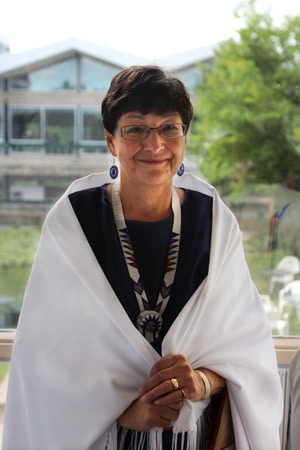
Sacred Circle members put on their finest regalia and traditional costumes for today’s procession to the Eucharist. There were ribbon shirts, Haida designs, moccasins and more.
“We saw truth and traditions through colour and culture,” said one memory keeper.
“It blessed me so much. It was beautiful,” said another.
- Anticipation: There’s lots of buzz about what will emerge this week. One memory keeper put it this way: “I think there’s going to be a lot of tears, laughter and more healing. I feel that we’re going through another step and we’re closer to where we want to be. The elders had a vision long ago of our own people ministering to our own people. That was our dream and it’s happening.”
- Talking circles resonate: Members gathered in their talking circles for the first time today. One memory keeper described how this felt: “When we are in the circle, I like listening to what’s happened. It’s still the same things that we are going through in our communities. We’re not rich, but rich in the spirit. It’s the same stories, what we’re going through with our youth, addictions, suicide, young people in jail. Everything they’re going through I’m going through too. But we’re still going. No one’s giving up. We’re still going.”
- Being transfigured
In his homily at today’s Eucharist, Archbishop Fred Hiltz, Primate of the Anglican Church of Canada, said the process of self-determination was like the transfiguration.
Archbishop Hiltz said that over several decades, Indigenous Anglicans have gone from depression to dreams, from submission to self-determination.
He encouraged Sacred Circle members with Jesus’s words to the disciples: “Get up. Do not be afraid.”
Memory keepers were moved by this message.
“We’re on the mountain right now,” said one. “The transfiguration is going to be right in front of our eyes this week.”
- Continuing the walk
Yesterday some 20 walkers arrived at the Wilderness Edge Retreat Centre in Pinawa, kicking off Sacred Circle by demonstrating the theme: “Walking the dream”. Two groups joined together to complete the final leg—one from Beausejour and one from Sagkeeng Nation.
“Today was a continuation of the walk,” said a memory keeper. “Many of us were joining together from different places.”
“Just like on our walk, it is good to see the youth and elders together. Something special happens then.”
Day 1 daily reflection (PDF)
- The walkers arrive: Some 20 people walked from Beausejour, Man., to Pinawa, Man., to raise awareness about the Sacred Circle and its theme, “Walking the Dream.” This highlights video shows the hard work and how the symbolism points to the Promised Land. (video)
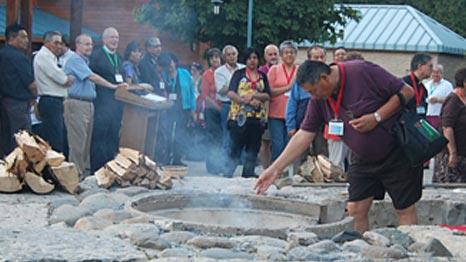
- Lighting the sacred fire: At sunset on the first night of Sacred Circle, the sacred fire was lit and tended by an elder from a local community. Set at the centre of the Wilderness Edge Retreat Centre in Pinawa, the fire would continue to burn throughout the conference as a sign of prayer, presence and community. (video)
- The Opening Eucharist of Sacred Circle on Aug. 6 included a vibrant procession, excerpts from the Primate’s homily and blessings from four bishops in four different languages. (video)