
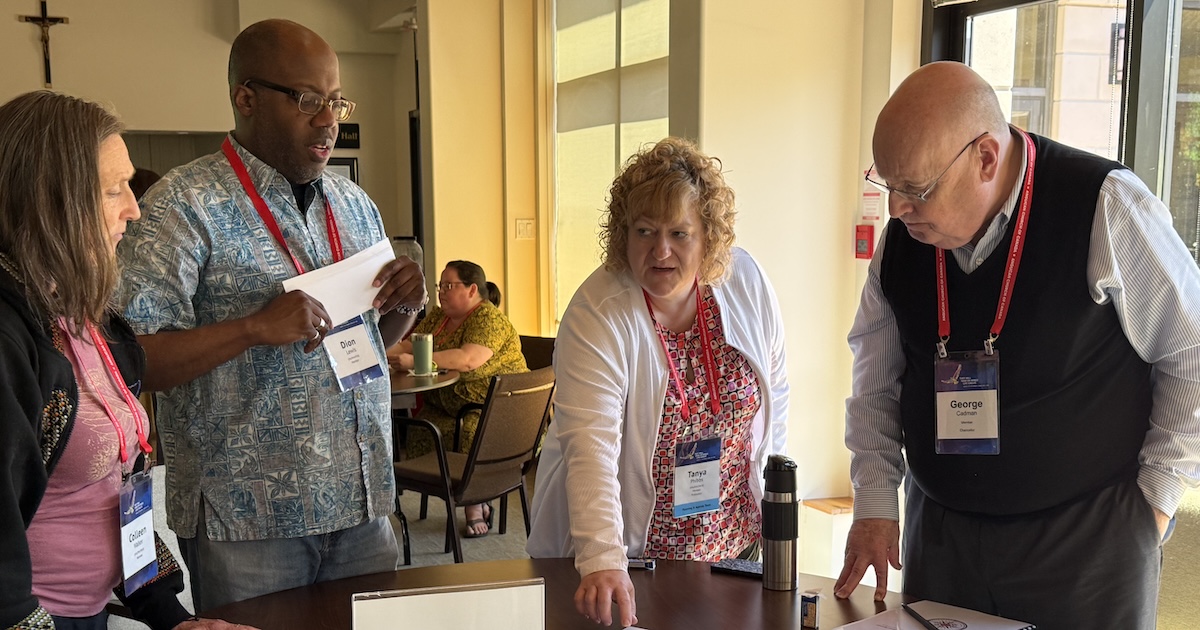
Members of Council of General Synod (CoGS) gathered at the Queen of Apostles Renewal Centre in Mississauga, Ont. at 9 a.m. EDT.
Opening Eucharist
Archbishop Shane Parker, Primate of the Anglican Church of Canada, presided and Archbishop Chris Harper, Presiding Elder of Sacred Circle, delivered the homily at the opening worship and Eucharist in the chapel.
Members took a break from 10:05 a.m. to 10:20 a.m.
Revisiting: Needs, Expectations and Mandate
Archdeacon Rhonda Waters, co-chair of the Planning and Agenda Team, reminded CoGS of its mandate. Council reviewed the needs and expectations, identified at their last meeting in November 2025, of voting members, partners, media and Church House staff.
Omnibus Motion
CoGS passed an omnibus motion extending courtesies; approving minutes from their Nov. 27-30, 2025 meeting; adopting the most recent version of the agenda and accepting regrets for the current meeting; and receiving annex documents for the agenda.
Primate’s Opening Remarks
Parker recounted events since General Synod 2025, when he was elected Primate. At that meeting, more than 90 per cent of General Synod members had approved the pathways for change recommended by the Primate’s Commission on Proclaiming the Gospel in the 21st Century, based on extensive consultation, and allocated $2 million to implement them. “It is not a business-as-usual triennium,” the Primate said. In his conversations with officers of General Synod, he said, three major pillars of work had emerged: property, Church House, and implementing the pathways.
The Anglican Church of Canada is in a period of cultural change, Parker said, in which everything must be predicated on thinking and acting differently to carry out change. He described actual, accomplished changes, as well as areas that are aspirational or need further work. The church’s national office known as Church House has made staffing changes and clarified its work, he said, reflecting the expressed desire of General Synod for a national office that costs less and acts differently.
Church House is now more focused on functions typical of a provincial office within the worldwide Anglican Communion, the Primate said, noting that very few provinces have large bureaucracies. The Anglican Church of Canada is one of two provinces where the Primate is not a diocesan bishop, he added, though that could change in the future. Relational work is a key focus of Church House, Parker said.
The Primate cited Indigenous ministries and communications as examples of major shifts in how Church House operates. Rather than an Indigenous Ministries department, the national church will now house an Office of Sacred Circle, which remains under the financial and legal umbrella of the Anglican Church of Canada but as far as possible is autonomous and guided by the Anglican Council of Indigenous Peoples (ACIP). Parker also detailed a closer relationship between communications and development and said CoGS would hear about planned changes to the church’s communication mandate, which he fully supported.
Parker pointed to actual change regarding the property pillar. The church has made further progress in negotiating its exit from a lease that would have seen Church House move from its current Toronto location of 80 Hayden Street to 300 Bloor Street West. Work is being done to optimize and monetize its current space at 80 Hayden so the resulting revenue can largely cover the cost of operations of the national office. He added that this would have the effect of lowering expectations on dioceses to fund those operations through proportional giving.
Regarding implementation of the pathways, Parker noted that change will need to happen in ways work commissioned or required by General Synod is done. Future changes might include projects having their own self-contained budgets, given lack of desire to fund a large church bureaucracy.
Parker laid out a scenario for ongoing work of CoGS over the 2025-2028 triennium, with the council currently in Year Two:
- Year One (2025/6)—Work to achieve results in three pillars is undertaken by CoGS and its transformation and property task forces, with Church House.
- Year Two (2026/7)—Work to achieve results in three pillars continues. Begin to evaluate and assess what can be accomplished in this triennium.
- Year Three (2027/8)—Work wraps up and new triennial priorities or projects are determined, to be approved by CoGS for adoption by General Synod 2028.
The Primate expressed hope that General Synod would adopt a triennial strategic cycle as its modus operandi going forward. While the church can be guided by its five transformational commitments, he said, its strategic direction needed to be more focused and disciplined.
Archdeacon Jordan Haynie Ware, clergy member for the ecclesiastical province of Northern Lights, asked the Primate how CoGS could balance General Synod’s desire to cut costs with providing services Anglicans expect, drawing a comparison to municipal budgets. Parker said church governance bodies would need to consider this question, but that General Synod would ultimately determine what it wants in its national office. Many Anglicans across the church are organizing themselves to do valuable ministry, he added, offering the example of Anglican Deacons Canada and the Refugee Sponsorship Network.
Moving on to the primacy, Parker said the work of the Primate is highly relational, interactive and representational. Visits to dioceses are a critical part of the job of Primate, he said, both in bringing an expression of the national church to local churches and in understanding the large body the Primate is called to guide and lead.
In his travels to dioceses since 2025, Parker said he had heard two major themes from Anglicans: people want to love their church, and they want to have hope. The Primate’s support for changes in the mandate for the national church’s Communications function reflected the need, he said, to tell stories about the church in a way that is regular, strategic, inclusive and accurate. “There is incredible ministry happening across our church,” he said, which needed to guide the church’s reporting and communication.
Pillars of Change: Pathway 1
Janet Marshall and Andrew Stephens-Rennie, co-chairs of the Transformation Task Force, summarized to CoGS the content of each pathway and next steps in their implementation. The six pathways are:
- Pathway 1: Creating a smaller, simpler governance structure that supports the church proclaiming the Gospel more effectively in local communities.
- Pathway 2: Designing a clear, transparent and manageable structure and system (policies, procedures, processes) for the ministries and work of the church at the national level.
- Pathway 3: Shaping our governance to invite, reflect and represent our diversity in participation and decision-making.
- Pathway 4: Telling the story of the Gospel, sharing stories of our ministries, and participating in national and international conversations.
- Pathway 5: Developing our partnership as Indigenous and non-Indigenous church in ways that live our commitment to the truth and reconciliation efforts of the Anglican Church of Canada.
- Pathway 6: Updating and clarifying the identity of the Council of the North and building capacity towards financial self-sufficiency.
The first year of the triennium saw work on each pathway to achieve clarity regarding their scope and relationships, Marshall said. It had revealed timely initiatives that were ready to go, as well as the need for increased clarity and transparency. Some situations had changed, some initiatives were legislatively or structurally complex, and some would take longer than a triennium, with implementation of the pathways taking place on different timelines.
The Transformation Task Force will next identify and structure how the pathways overlap and inform each other, Marshall said, while working on major questions arising. Examples of the latter include how General Synod expresses core functions of communicating, connecting and convening; and how work of General Synod gets identified, prioritized and done. The task force will work with CoGS to assess what can be accomplished this triennium and what will extend into the next one, Marshall said.
Stephens-Rennie invited CoGS, working in table groups, to rank priorities related to Pathway 1. Table groups discussed and provided feedback.
Members broke for lunch from noon to 1:30 p.m.
Bible Study
Archdeacon Cheryl Palmer, chaplain to CoGS, led Bible study and gospel-based discipleship. Council members read and reflected upon Matthew 14:22-33, in which Jesus walks on water during a storm at sea before his disciples.
Pillars of Change: Church House Pillar
Offering an update on the Church House pillar, Andrea Mann, general secretary of General Synod, said, “Irreversible change has occurred at Church House.” Most people connected have been supportive and prayerful, she said. Mann agreed the changes suggest Church House is becoming like an office of the Province of Canada within the global Anglican Communion, leaving behind its model from previous decades by becoming smaller in size; more canonical and constitutional in its core functions, relational in its work and focused on synodical priorities of the Canadian church. She hoped such a Church House would be meaningful to the Anglican Communion’s efforts to decolonize its structures.
As of July 1, Church House will comprise 31 full-time and part-time staff members and two additional contract workers, Mann said. An anticipated retirement later this year will bring total staff down to 30. She described the changes as “not just a story of staff reduction, but also strategic growth and development.” The national office of General Synod was close to finalizing a memorandum of agreement with the Anglican Foundation of Canada and Alongside Hope for a shared legacy-giving office.
While Church House was changing, work of its departments had not been abandoned, Mann said. Some aspects of the work of Global Relations and Faith, Worship and Ministry, dismantled as separate ministries in Church House, continued through relational responsibilities of the Primate and general secretary as well as senior advisory staff. Changes in staffing levels did mean ways of work in current and historic priorities received from CoGS and General Synod had ended, Mann said, such as all bilateral missions with other provinces of the Anglican Communion; events such as the biennial Canadian Lutheran Anglican Youth (CLAY) gathering would be served in other ways. Several working groups had been suspended while work on implementing the pathways continues, in order to avoid duplication of effort in related areas. An example is the Dismantling Racism Task Force, which is suspended as the work of Pathway 3 proceeds.
“All of this has required tremendous diligence, maturity, good humour and hard work from Church House and volunteers,” Mann said. Reiterating her remarks from the November meeting of CoGS, she said staff were working to ensure deliverables from General Synod 2025 while laying the foundation for work that would continue past the triennium. “Where there may be trepidation, there is also trust,” she said.
Archdeacon Lauren Schoeck, clergy member for the ecclesiastical province of Northern Lights, asked if there had been conversations about CLAY with the Evangelical Lutheran Church in Canada (ELCIC), a full communion partner of the Anglican Church of Canada. Mann said she and other senior staff have worked with ELCIC leadership on an evaluation of the CLAY gathering, with a report to the National Youth Council likely being brought to CoGS for further consideration. “We are working together to understand how CLAY might have a future in a new way in both denominations,” Mann said.
Pillars of Change: Property Pillar
Mann also offered an update on the Property Task Force that CoGS had established regarding the use of the national office space at 80 Hayden. The task force continued its oversight of the first phase of this process, Mann said, having hired an architectural contractor to look at Church House, rationalize environmental impact of current operations, and look at revenue opportunities. The consultant was nearing completion of the consultation process after interviews, digital spatial measuring, etc.
An impetus for change is that the combined staff of Church House, Alongside Hope and the Anglican Foundation of Canada are “now working in a much bigger space than we need,” Mann said. Facilities manager Virginia Douglas and her team continue to manage the building and clear unused office equipment and warehouse space.
The plan moving forward is to “right-size” 80 Hayden and finance Church House operations from 10-year lease tenants if recommendations from the Property Task Force head in that direction, Mann said, reducing operational costs and environmental impacts as well as proportional giving from dioceses necessary to support the national office. Parker said any expenditures associated with repositioning would be a decision Church House would bring to CoGS.
Chancellor George Cadman briefed CoGS on a legal matter, which required council to move in camera.
Pillars of Change: Pathway 4
Jamie Tomlinson, chair of the Communications Co-ordinating Committee/Pathway 4 team, and Henrieta Paukov, the national church’s communications director, gave an update on the work of Pathway 4, which is tasked with drawing up a new mandate and strategy for the national church’s Communications function. Tomlinson said the committee had looked at the state of the church’s national Communications function to assess what was working and not working, and develop a strategy moving forward.
Sharing an analysis of the current Communications function’s strengths, weaknesses, threats and opportunities, Tomlinson said the current mandate for the Communications function is overly broad and vague. Communications staff are highly skilled but have historically been burdened by competing siloed priorities. While the Anglican Journal serves as an essential information service that provides cost-saving distribution for diocesan papers, it requires a growing subsidy due to its deficit.
Ongoing structural tension between corporate communications and journalism is accompanied by legal, reputational and relational risks that the communications team must manage. The pathways note Anglicans have a strong desire for good communication, he added. Shifting the national Communications function from a service department model to a strategic partner model, Tomlinson said, would offer numerous benefits that would put the national team in a good position to inform, inspire and resource Anglicans.
Tomlinson presented a new three-fold mandate for the Communications function of the national church that would include corporate communications, development/fundraising communications and resources facilitation and sharing. Under this new mandate, the Anglican Journal would be the voice of the Anglican Church of Canada and part of its larger communications strategy rather than a separate journalistic enterprise. This change would ensure strategic alignment, effective risk management and responsible stewardship of resources for all communications products of the national church, including the Journal.
The new mandate, Tomlinson added, would assist pathways 1 and 2 by supporting accountability and transparency, and pathways 5 and 6 by supporting communications as well as fundraising that would ultimately serve Indigenous and northern communities. He outlined ways that communications tactics could support transparency and accountability, including highlights and minutes from CoGS and General Synod; livestreaming of General Synod, news stories and updates on Anglican.ca, and public posting of audited financial statements.
In a discussion, CoGS members asked how moving away from a model in which the Anglican Journal is tasked with providing journalistic integrity would affect accountability and transparency. Paukov said accountability and transparency are important for all organizations and result from effective, responsible governance, but that embedding a journalistic function in an organization is not a recognized best practice in the corporate or non-profit sectors. Tomlinson said the current size of the church meant tension between corporate communications and independent journalism—with potential for situations of institutional risk that could not be effectively managed—were no longer sustainable.
The work of all pathways including Pathway 4, Paukov said, is to prepare the church for a time when it will be lighter on resources. Given an annual deficit of around $500,000 for the Anglican Journal, she said, the intent behind bringing the Journal closer to being a strategic tool for communications was to ensure that the Journal, like all tools that Anglicans are paying for, unequivocally supports the mission of the church and is accountable to CoGS, General Synod and leadership at Church House.
Members took a break from 3:30 to 3:45 p.m.
Pillars of Change: Pathway 4 (cont’d)
Members unanimously passed a motion establishing the new mandate for the national church’s Communications function.
Resolution
That the Council of the General Synod approve the new mandate for the National Church’s Communications functions described in the report of the Communications Coordinating Committee/Pathways 4 Team dated May 22, 2026 and directs the Communications Coordinating Committee to prepare revised Terms of Reference aligned with the Mandate for approval by the Council.
Pillars of Change: Pathway 5
Archdeacon Travis Enright, co-chair of ACIP, presented an update on Pathway 5 that reiterated notions of shared space; Indigenous identity based on language, land and lodge; distinctions between Canadian and traditional Indigenous models of governing; jurisdiction of the Anglican Church of Canada with rights and responsibilities at diocesan, provincial and national levels; and infrastructure of the Office of Sacred Circle as the administrative and pastoral support body of the self-determining Indigenous church. The latter office, he said, is funded by General Synod, accountable to Sacred Circle, and “governed in kinship, not jurisdiction” with representation based on regional council fires.
Pathway 5 work, Enright said, involves creating a church-to-church partnership based on a universal and mutual model, in which Sacred Circle and the Anglican Church of Canada “recognize each other as whole and complete expressions of the Gospel, sharing one baptism, one creed, and one Anglican Communion while each governing their own life, spirituality, and ministry in their own way.” Between Sacred Circle and General Synod is Pathway 5—representing a shared life that Enright called kiskinohamatowikamik, a Cree word which means “the place where we learn together.”
Next steps will involve generating dialogue, proposals and recommendations as the Pathway 5 team prepares a work plan for the balance of the triennium. Five dialogues will produce proposals and recommendations that will be brought to General Synod 2028. Topics of each dialogue will include:
- Church-to-church relationship. Develop a clear, publicly communicated understanding of church-to-church partnership: what it means for Sacred Circle and General Synod to be both independent and connected as the Anglican Church of Canada. Output: Agreed definition for General Synod 2028.
- Governance canons. Create effective governance canons that support and clearly articulate the mutual relationship between Sacred Circle and General Synod—giving the partnership canonical, structural form. Output: Proposed canon revisions for General Synod 2028.
- General Synod decision-making. Develop a new model of committee processes and decision-making for the meeting of General Synod that enables full Indigenous participation and honest conversation. Connected to pathways 1, 2 and 3. Output: New committee model for General Synod 2028.
- Communication strategy. Connected to Pathway 4. Support Sacred Circle to build an in-depth communication strategy across all dioceses, increasing awareness of the Covenant and Our Way of Life and the work of Sacred Circle. Encourage active consultation and information-sharing among bishops across the diocese and council fires. Three focus areas: Covenant and Our Way of Life literacy diocese-wide, bishop-to-bishop consultation mechanisms, Sacred Circle voice in provincial and diocesan life. Output: Diocesan communications strategy and bishop engagement framework.
- Council of the North conversation. Connected to Pathway 6. An in-depth conversation between General Synod, Sacred Circle and the Council of the North to determine how all three can move forward in a good way. This conversation informs and is done in partnership with the work of Pathway 6. Three parties at the council fire: General Synod, historic non-Indigenous church; Sacred Circle, self-determining Indigenous Church; Council of the North, northern regional ministry. Output: Agreed path forward for all three, informing Pathway 6 recommendations.
Members took a break for dinner from 5 to 7 p.m.
Pillars of Change: Transformation Task Force Overview
Stephens-Rennie presented a high-level overview from the Transformation Task Force on work around each of the pathways. Based on the current plan for the triennium, in year 1, CoGS and the Transformation Task Force undertake work to achieve the pathways results, supported by Church House. In year 2—where the church currently is—work continues to achieve results and CoGS establishes an evaluation and priority-setting process at mid-year. In year 3, work wraps up, an Evaluation Priority Process evaluates efforts and determines new triennial priorities, and CoGS approves priorities for final adoption by General Synod.
On that basis, Stephens-Rennie described planned work on each of the pathways in two areas, operations, and consultation and evaluation:
- Pathway 1—Organizational structure (governance)
- Year 1: Refine and focus mandate, design engagement: what is “essential, beneficial, an encumbrance.” Consult House of Bishops.
- Year 2: Bring refined mandate to CoGS, design provincial engagement, propose approach to General Synod governance and conducting synodical work. Consult provincial councils and pathway 2 and 3 teams.
- Year 3: TBD. Consult with pathway 2 and 3 teams to recommend approaches to staffing in response to General Synod projects.
- Pathway 2—Management and restructuring
- Year 1: Reset scope in conjunction with management decisions and actions; develop change management framework; prepare initial recommendations for General Synod executive leadership. Prepare survey to engage staff and stakeholders.
- Year 2: Coordinate with pathways 1 and 3 teams to identify operational changes; advise on and implement change management practices; iterate based on consultation with key stakeholders. Survey key stakeholders; consult stakeholders to fill in knowledge gaps.
- Year 3: Finalize implementation of operational changes; finalize Church House organization chart; recommend accountability structures relative to governance outcomes. Consult with pathway 1 and 3 teams to recommend approaches to staffing in response to General Synod projects.
- Pathway 3—Inclusion and diversity in decision-making
- Year 1: Assess scope and internal capacity; develop request for proposals for diversity, equity and inclusion governance consultant. Baseline consultation with CoGS.
- Year 2: Situational analysis and structural audit; develop roadmap towards inclusive decision-making (structures and processes). Gather perspective; engage pathway 1, 2 and 5 teams; engage CoGS.
- Year 3: Implement roadmap from current state towards desired participation. Consult with pathway 1 and 2 teams to recommend approaches to staffing in response to General Synod projects.
- Pathway 4—Communications
- Year 1: Examine current mandate; complete situational analysis; propose clear mandate for communications function. Engage communications committee, Transformation Task Force, CoGS; consult pathways teams.
- Year 2: Design and implement strategic communications plan based on new mandate; develop revised terms of reference for Communications Coordinating Committee. Design evaluation approach; consult and support pathways teams.
- Year 3: Implement and iterate strategic communications plan. Report on impacts of mandate shift from “service department” to “strategic partner.” Evaluate impacts of mandate shift; consult and support pathways teams.
- Pathway 5—Walking together in partnership
- Year 1: Develop action plan; establish Office of Sacred Circle; establish Pathway 5 team. Develop communications among Transformation Task Force and ACIP co-chairs.
- Year 2: Generate dialogue, proposals and recommendations in line with action plan. Consult General Synod, ACIP, Council of the North; design evaluation project; engage pathway 1, 2 and 3 teams.
- Year 3: Evaluate and iterate; report on successes and challenges; set priorities for next triennium.
- Pathway 6—Ministry in remote northern communities
- Year 1: Revise and update Council of the North handbook. Onboard new Council of the North bishops.
- Year 2: Develop communications strategy with General Synod communications support; develop fundraising best practices and tools; train leaders in storytelling and fundraising. Consult General Synod, ACIP, Council of the North; design evaluation approach.
- Year 3: Clarify relationship between Council of the North and General Synod. Report on successes and challenges. Set priorities for next triennium.
Marshall presented the results of the ranking by CoGS of priorities related to Pathway 1, with points assigned inversely based on how highly council members ranked them. In order of priority from highest to lowest, with some items tied, Pathway 1 priorities are:
- Make participation in decision-making structures more accessible to a broader range of people.
- Designing a transparent evaluation and accountability process for General Synod’s operation and work.
- Design new processes for the creation of General Synod committees, task forces, working groups, etc.
- Reimagine relationship between General Synod and the Council of the North.
- Address number and size of provinces.
- Determine process to reduce number of dioceses. Reimagine relationship between Anglican Church of Canada’s provincial structures and those of Sacred Circle. (Tie)
- Reimagine relationship between General Synod and Anglican Foundation of Canada. Reimagine relationship between Anglican Church of Canada’s national structures and those of Sacred Circle. (Tie)
- Encourage cooperation among dioceses for shared administration.
- Encourage cooperation among dioceses for shared programming.
- Reimagine relationship between General Synod and Anglican Pension Plan. Reimagine relationship between General Synod and Alongside Hope. (Tie)
- Consider other models of restructuring primacy.
Some CoGS members expressed surprise about the ordering of priorities. Marshall noted a consistent theme: “In all of this work, the language of clarifying is woven through absolutely everything.” Council engaged in 10 minutes of table group discussion on ways to clarify or better communicate the pathways.
Evening Prayer
CoGS members concluded the day with prayer in the chapel.
An evening social took place from 8:30 to 11 p.m.