
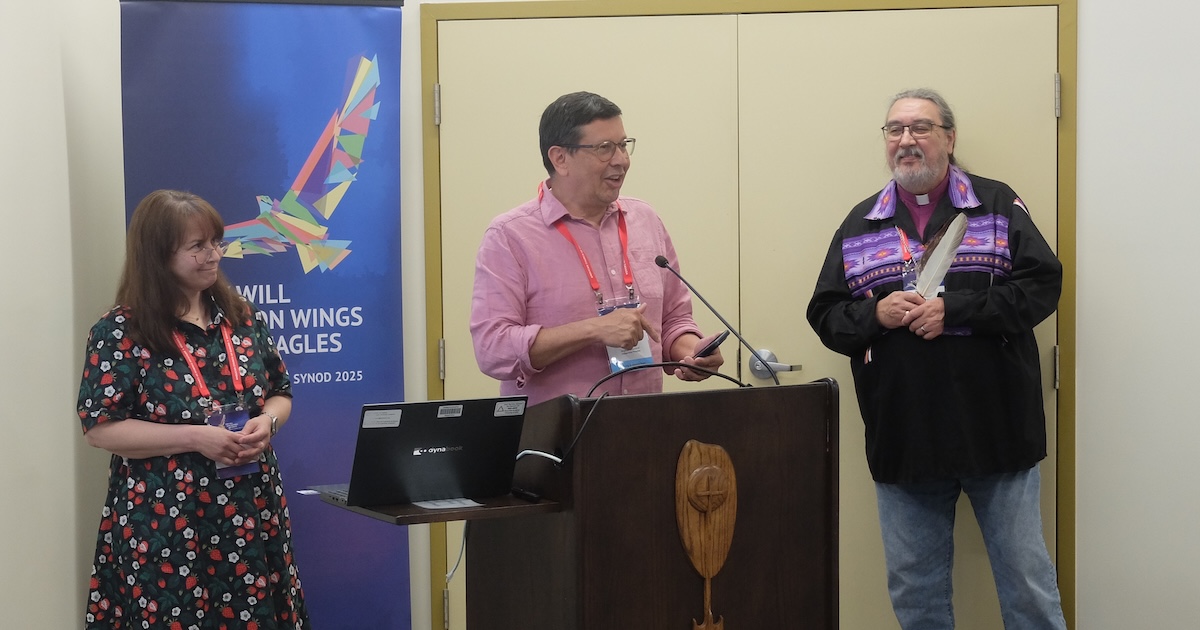
Members of the Council of the General Synod (CoGS) gathered at the Queen of Apostles Renewal Centre in Mississauga, Ont. at 9 a.m. EDT.
Tracking CoGS Deliverables
General Secretary Andrea Mann offered updates on resolutions that General Synod had forwarded to CoGS, which she grouped into three categories. The first involved resolutions for which General Synod had requested action from CoGS:
- A125—United Church of Canada 100th Anniversary. Tabled until further notice.
- A126—Presbyterian Church in Canada 100th Anniversary. To be addressed at future meeting of triennium.
- A180—Creating Pathways for the Transformational Change of the General Synod. Work ongoing through triennium, with CoGS receiving update at current meeting.
- A020—Funding the Pathways. Update on total expenses to date being presented to CoGS at current meeting. $5,500 has been spent from Transformation Task Force budget thus far in 2026, as deposit for contracted services of diversity, equity and inclusion governance consultants.
- A202-R1—Tenets of Disability Theology. Public Witness for Social and Ecological Justice Committee to focus on engaging issues of disability justice, accessibility and inclusion, undertaking study of The Disabled God as its key text, and gathering resources from Anglican Communion and ecumenical partners already engaged in this work.
- B001—Council of the North Funding. Funding to remain at 2025 level throughout this triennium.
- C001—Modification to Canon III, Part 1, 4. B). Governance Working Group to report further at current meeting.
- C009—General Synod Spending Limit. Financial Management Committee discussions underway with deliverable scheduled for completion.
- C013—Establishing National Youth Council. Proposed terms of reference to be discussed at current CoGS meeting.
- C015—Youth Involvement on the Council of the General Synod. Governance Working Group flagged item for potential referral to them.
- C014—Review of Voting and Electoral Processes. Scheduled for completion. Governance Working Group flagged item for potential referral to them.
The second group of resolutions was not approved by General Synod but referred to CoGS for decision:
- C006-R1—Use of Non-Disclosure and Non-Disparagement Agreements (NDAs). Planning and Agenda Team analyzed CoGS discussion notes from November 2025 and identified next steps. Further engagement at current meeting.
- C004—Universal Basic Income. Request to council has been delivered, with primate writing to leaders.
- C005—Artificial Intelligence Use in the Church. Preliminary report prepared, with further engagement at current meeting. Governance Working Group flagged item for potential referral to them.
- C007—On the 1700th Anniversary of the Council of Nicaea. Delivered.
- C008—Opposition to Christian Nationalism. Delivered.
The third group of resolutions was approved by General Synod and referred to CoGS for monitoring:
- A120—Theological Statement on the Diaconate. Work ongoing through General Synod 2028. Update in June 2026 Faith, Worship and Ministry committee report.
- A121—Practices for a Restored Diaconate. Work ongoing through General Synod 2028. Update in June 2026 Faith, Worship and Ministry committee report.
- A122—Feast of the Creator. Resource completed and included in Faith, Worship and Ministry committee report for action.
- A123—Addressing Anti-Judaism in Holy Week and Easter. Delivered.
- A124-R1—Thematic Revised Common Lectionary. Delivered.
- A160—Just Peace in the Philippines. No report currently.
- A161—A National Strategy for Local Ministries of Hospitality and Advocacy with Migrant Workers in Canada. Staff connected with key Anglican leaders engaged in ministry with migrant workers and invited participation in conversation to identify next steps. Further information in Public Witness for Social and Ecological Justice coordinating committee report.
- A200—The Fossil Fuel Non-Proliferation Treaty. Delivered.
- C002—Emancipation Sunday. Refer to Faith, Worship and Ministry coordinating committee report for action at current meeting.
- C003-R1—Queer Interfaith Coalition Open Letter to the Canadian Government. Action assigned to each lay person, deacon, priest and bishop in the Anglican Church of Canada. “Happy Pride,” Mann told CoGS.
- C011—Expression of Support for Those in the Land of the Holy One. Delivered.
- C012—Arms Embargo on Israel. Delivered. Primate called on prime minister for action on “obscene violence” in Gaza.
Overall, work on 23 of 28 General Synod resolutions referred to CoGS was either in progress or had been delivered, Mann said. “I think that’s pretty darn good.” Work plans were in development for the remaining five resolutions, she added.
Faith, Worship, and Ministry Committee
Dion Lewis, CoGS representative and co-chair of the Faith, Worship and Ministry Committee, brought forward several motions, which CoGS passed.
Resolution
Be it resolved that this Council of the General Synod:
- Authorize Ministry with the Sick and Dying in the Context of MAiD [medical assistance in dying] for trial use, evaluation, and feedback where provided by the ordinary.
- Request that the Church House Communications function post the text in the Trial Use webpage of www.anglican.ca along with its feedback form.
- Mandate the current Ministry with the Sick and Dying Task Group to monitor feedback and to be reconstituted to develop a final text during the year 2027 to bring this work back to the Council of the General Synod in final form in anticipation of legislative action by the General Synod of 2028.
Resolution
Be it resolved that this Council of the General Synod:
- Authorize Ministère auprès des personnes maladies. Authorize Propres Semaine sainte et Pâques.
- Authorize the new wording of la Prière du Seigneur (the Lord’s Prayer), the current ecumenical consensus on the French-language version, as follows: « Et ne nous soumets pas à la tentation, mais délivre-nous du mal » to be replaced with: « Et ne nous laisse pas entrer en tentation, mais délivre-nous du mal. » Request General Synod Communications to make the changes in the online and print version of French-language and bilingual French-English liturgical texts with respect to the Lord’s Prayer.
Resolution
Be it resolved that this Council of General Synod:
- Receive the report The Bible in Public Worship.
- Commend the report The Bible in Public Worship to diocesan bishops for their use.
Resolution
Be it resolved that this Council of the General Synod:
- Receive the Report on Liturgical Advisory Committee Surveys, with Recommendations.
- Commend the report to any future body of the General Synod that may undertake liturgical work.
Resolution
Be it resolved that this Council of the General Synod:
- Authorize Good Friday: An Alternative Liturgy for trial use, evaluation, and feedback where permitted by the ordinary.
- Request that the Church House Communications function post the text in the Trial Use webpage of www.anglican.ca along with its feedback form.
- Mandate an appropriate group to monitor feedback and to be reconstituted to develop a final text during the year 2027 to bring this work back to the Council of the General Synod in final form in anticipation of legislative action by the General Synod of 2028.
Resolution
Be it resolved that this Council of the General Synod:
- Receive the resource Behold what you are; Become what you receive: a resource for learning, discussion and reflection on the fundamental principles of liturgy in the Anglican Church of Canada.
- Commend this resource to the church and to theological colleges for the purposes of study, teaching and use in other formative and educational contexts.
- Direct the Church House Communications function to publish the resource on the General Synod’s website.
Resolution
Be it resolved that this Council of the General Synod:
- Authorize Emancipation Sunday: Liturgical Resources for trial use, evaluation and feedback where permitted by the ordinary.
- Request that the Church House Communications function post the text in the Trial Use webpage of www.anglican.ca along with its feedback form.
- Mandate an appropriate group to monitor feedback and to be reconstituted to develop a final text during the year 2027 to bring this work back to the Council of the General Synod in final form in anticipation of legislative action by the General Synod of 2028.
- Commend Emancipation Day: Education Resources and Bible Studies to the church.
Resolution
Be it resolved that this Council of the General Synod:
- Receive the Final Report of the Second Phase (2023-2025) of the Anglican-Mennonite Dialogue in Canada.
- Commend it to the wider church for review and study.
- Direct the Office of the Primate and General Secretary to pursue further recommendations with Mennonite Church Canada, Indigenous church partners, and our full communion partners towards advancing recommendations 1-4 of the report, and to ensure a report on progress is made to the Council of the General Synod before summer 2028.
Members broke for coffee from 10:30 to 10:45 a.m.
Governance Working Group
Chancellor George Cadman, chair of the Governance Working Group, clarified Resolution C001-R1, which General Synod referred to CoGS to examine all that would be necessary to modify Canon III, Part 1, 4 B, which details the primacy in the Anglican Church of Canada. The canon currently requires that as soon as practicable after election, but no more than 90 days, the primate-elect shall resign episcopal and metropolitical offices held at the time of their election to primacy. General Synod had contemplated that the primate may at their discretion retain diocesan office but would have to resign metropolitical office, Cadman said, which was referred to the Governance Working Group for analysis.
The Governance Working Group report, Cadman said, outlined three points for consideration. First, any changes would require not simply amending Canon III, but an amendment to Canon XVIII, the discipline canon. Secondly, any such amendments would not affect the primatial election at General Synod 2028, because thirdly, canonical amendments must be passed at two successive General Synods. However, Cadman noted that work of CoGS could be brought forward at a special General Synod before General Synod 2028, which could result in adoption of the change.
Council discussed and questioned the ramifications of the primate also being a diocesan bishop, which is the case in all provinces of the Anglican Communion other than Canada and the United States, opting to revisit the matter later and give members time for reflection.
2025 Audited Financial Statements
Beng Wee, treasurer of General Synod, presented the 2025 audited financial statements for General Synod and the Consolidated Trust Fund, which he described as good news. “Basically, it’s a boring report and that’s a good report in this context,” Wee said. A rise in investment outcome had mitigated loss in revenue, he said.
CoGS passed two motions approving the financial statements.
Resolution
That this Council of the General Synod approve the draft audited Consolidated Financial Statements of the General Synod of the Anglican Church of Canada as at December 31, 2025, as presented.
Resolution
That this Council of the General Synod approve the draft audited Financial Statements of the Consolidated Trust Fund of the Anglican Church of Canada as at December 31, 2025, as presented.
Members broke for lunch from noon to 1:30 p.m.
Bible Study
Archdeacon Cheryl Palmer, chaplain to CoGS, led council in Bible study and gospel-based discipleship. Members reflected on John 1:1-18, which introduces Jesus as the eternal Word who became human to reveal the Light of God to the world.
Anglican Council of Indigenous Peoples
Presiding Elder and National Indigenous Archbishop Chris Harper introduced the report from the Anglican Council of Indigenous Peoples (ACIP). Lt.-Col. the Rev. Catherine Askew and Archdeacon Travis Enright, co-chairs of ACIP, recounted the background over decades leading up to the establishment of Sacred Circle as the self-determining Indigenous church.
Enright described grief that Indigenous Anglicans had dealt with since the COVID-19 pandemic, with the death of many elders including the Rev. Canon Ginny Doctor, longtime Indigenous Ministries coordinator; and the 2022 resignation of Mark MacDonald as national Indigenous Anglican archbishop. “We are a people of the drum,” Enright said. Finding a new drumbeat to animate their work, he said, required honouring those who had gone before. Enright and the Rev. Canon Scott Sharman, the Anglican Church of Canada’s animator for ecumenical and interfaith relations, sang a healing song together.
Providing an overview on Sacred Circle’s representation through 12 regional council fires, Enright said Sacred Circle’s work plan for the next three years would involve clarifying governance, showing up for each other, growing their own leaders (“Indigenous leaders shaped by Indigenous communities”), developing worship that centres local Indigenous liturgy in shared worship, and building a structured financial plan with the Anglican Church of Canada that aligns finances with the other priority areas.
2026 YTD Statement
Amal Attia, chief financial officer, presented the 2026 year-to-date financial statement for General Synod. She said General Synod was moving towards a lower deficit and more diverse sources of revenue.
Refugee Network Panel
Archdeacon Bill Mous and Ishita Ghose, refugee coordinators for the dioceses of Niagara and Ottawa, respectively, gave an overview of refugee sponsorship across the Anglican Church of Canada, looking ahead to World Refugee Day on June 20.
Fifteen Anglican dioceses are sponsorship agreement holders (SAHs), established organizations that have signed a formal agreement with the Canadian government to privately sponsor refugees. Mous said that Jesus, himself a refugee, invited us to ministry that transforms lives—and that with increasing conflicts and crises, the need to resettle refugees has never been greater. Anglican sponsorship significantly increased with the Syrian refugee crisis in 2015 and 2016.
In 2026, the Canadian government significantly reduced humanitarian admissions from outside Canada. In response, the Canadian Refugee SAH Association is calling for the government to commit to welcoming at least 27,000 privately sponsored refugees in 2027. Ghose and Mous implored CoGS members to support refugee sponsorship by providing SAHs with the resources they need, encouraging parishes to participate in sponsorship, advocating nationally for the federal government to increase the refugee sponsorship cap, celebrating Refugee Sunday at any time of year by sharing stories and lifting up the work of volunteers, and partnering with non-Anglican SAHs where needed.
Members broke for coffee from 3:30 to 3:45 p.m.
Terms of Reference
Prolocutor Phibbs presented motions on terms of reference for Resolution C006-R1, concerning non-disclosure and non-disparagement agreements; and the General Synod Planning Committee. Both carried.
Resolution
That the Council of the General Synod adopt the Terms of Reference for the CoGS Working Group on Non-Disclosure and Non-Disparagement Agreements.
Resolution
That the Council of the General Synod approve and adopt the Terms of Reference for the General Synod Planning Committee (GSPC), including its subcommittees, the Worship Committee, and the Local Arrangements Committee.
Nairobi-Cairo Proposals
The general secretary introduced Canon Alyson Barnett-Cowan, former director of Faith, Unity and Order for the Anglican Communion; and Sharman, who will soon transition from his current part-time role as the Anglican Church of Canada’s animator for ecumenical and interfaith relations to full-time national senior advisor on unity, faith and order. Both are members of the group currently studying proposed reforms to Anglican Communion structures, known as the Nairobi-Cairo Proposals, to inform delegates from the Anglican Church of Canada who will attend an upcoming Anglican Consultative Council (ACC) meeting in Belfast, Ireland. Delegates at the June 27-July 5 meeting will discuss and vote on whether the ACC endorses the proposals or will ask for further changes.
Barnett-Cowan and Sharman outlined the background and content of the Nairobi-Cairo Proposals, which involves two main proposals. The first proposal would change the definition of the Communion from provinces “in communion with the See of Canterbury” to provinces “in conference and connection with the See of Canterbury, by which they seek interdependently to foster the highest degree of communion possible one with another.” The second proposal initially called for a rotating presidency of the ACC, a role formerly held by the Archbishop of Canterbury; a 2026 supplement recommended eliminating the role of ACC president entirely.
CoGS members weighed in on the extent to which the Anglican Communion mattered to them; other affirmations, questions or concerns they might have about potential impact of the Nairobi-Cairo Proposals; and whether there might be any value in creating a working group to clarify Canadian Anglican perspectives at the Belfast conference. Table groups discussed and provided feedback, but CoGS did not set up a new working group related to the Nairobi-Cairo Proposals.
Members broke for a banquet dinner from 5 to 7 p.m.
Resolution C005 (Artificial Intelligence)
Ryan Weston, lead animator of Public Witness for Social and Ecological Justice, presented a review of Resolution C005, which directed CoGS to convene an artificial intelligence (AI) ethics task force, and outlined potential next steps. Discussions on AI have taken place through diocesan and ecumenical activities and conversations, Weston said, noting that the first encyclical of Pope Leo XIV deals extensively with AI.
CoGS engaged in table group discussions on what council should do next in addressing the issue of generative AI; who would need to be involved in this work going forward, and who could actively participate; and what other resources would be needed to undertake this work. Weston collected their notes to make available as council prepared to vote on a motion related to AI the next day.
Evening Prayer
Council held evening prayer in the chapel.
An evening social took place from 8:30 to 11 p.m.