
Members of Council of General Synod (CoGS) gathered at the Queen of Apostles Renewal Centre in Mississauga, Ont. at 9 a.m. EDT.
National Youth Council Terms of Reference
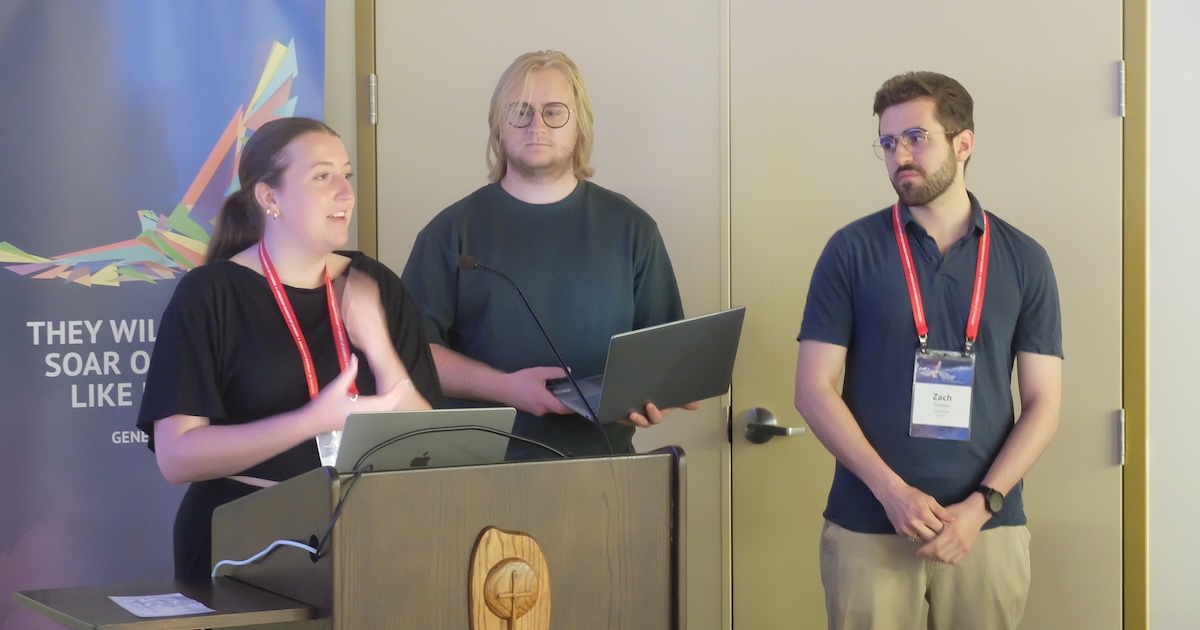
Paige Keller, youth member for the ecclesiastical province of Ontario; Zach Groves, lay member for the ecclesiastical province of B.C. and Yukon; and Noah Skinner, lay member for the province of Ontario, reported on formation of the National Youth Council and provided background to terms of reference that CoGS would vote on.
Groves said the immediate objective was a vote to formalize the existence of, and provide binding rules for, the National Youth Council, which would build up the terms of reference further over the course of the 2025-2028 triennium, addressing concerns such as safeguarding procedures and role definition. The members put forward three motions related to the National Youth Council, which carried.
Resolution
That the Council of the General Synod adopt and approve the National Youth Council (NYC) Terms of Reference (TOR) as presented by the NYC TOR Task Force.
Resolution
That this Council of the General Synod extend the term of the National Youth Council TOR Task Force so that it may work alongside the Church House Communications function to create the NYC application portal and share it across the country, and to establish the primary email account for the National Youth Council, with this extension to continue through the launch of the open national application process.
Resolution
That this Council of the General Synod empower the General Secretary to appoint five (5) members of the Council of the General Synod to the National Youth Council Initial Appointment Review Committee (IARC), which is mandated under the National Youth Council Terms of Reference to review all initial applicants to the National Youth Council and to select and present the initial appointments to the Council of the General Synod for approval by the conclusion of the fall 2026 CoGS meeting. This committee is to be populated by the end of July 2026.
Outstanding Motions
Two clergy members for the ecclesiastical province of the Northern Lights presented motions. Archdeacon Lauren Schoeck put forward a motion on the liturgical principles document “Behold What You Are, Become What You Receive,” while Archdeacon Jordan Haynie Ware presented two motions related to artificial intelligence (AI). Both carried.
Resolution
That this Council of the General Synod request that the communications function of General Synod research and provide the costing of making available “Behold What You Are, Become What You Receive” as a physical document available for purchase and report back to Council of the General Synod’s November meeting for action.
Resolution
That this Council of the General Synod direct the Office of the Primate and General Secretary to appoint a working group to develop Terms of Reference for an Artificial Intelligence (AI) Ethics Task Force that will help the church negotiate faithful engagement as generative artificial intelligence (genAI) technologies shift and to bring these terms of reference to the November 2026 meeting of the council for adoption.
The mandate of the task force should include:
- Review existing scholarly, ecumenical, and other relevant resources as well as craft original work, as appropriate, to assist dioceses, parishes, and individual members with the job of continuing to act in a manner consistent with our baptismal covenant.
- Provide guidance related to respect for intellectual property rights, Indigenous rights, personal data protection, environmental stewardship, and other virtues espoused by the Anglican Church of Canada as they find relevant.
- Consider policies or guiding principles for genAI use by staff, standing committees, and coordinating committees to ensure any such use in a fair, transparent, and consistent manner with these principles.
- Develop methods to distribute these principles to dioceses that wish to take up their own principles and procedures to guide genAI use.
Resolution
That this Council of General Synod direct the Office of the Primate and General Secretary to adopt as an interim policy on the use of artificial intelligence a policy identical to that adopted by the Anglican Foundation, until such time as this body can receive advice from a duly appointed ethics task force on this topic.
Partner Reflections
Schoeck, representative of CoGS to the Evangelical Lutheran Church in Canada (ELCIC) National Church Council, shared her experience attending the spring meeting of the latter in Calgary. The gathering included a visit to a local Moravian church, reflecting the full communion partnership of Anglicans, Lutherans and Moravians in Canada since 2023.
Similarly to how Anglicans are discussing pathways for change, Schoeck said, Lutherans engaged in a multi-year project of planning the future of their church: Facing Today – Dreaming for the Future. She described being moved by the process as Lutherans freely shared with each other aspects they felt were going too fast or that had been left out. “It was beautiful to see that actual deep listening that was happening,” she said. The ELCIC, she added, is also engaged in discussion on AI in partnership with the United Church of Canada.
The Rev. Chris Bishopp, ELCIC representative to CoGS, spoke about the deepening connections between the Anglican Church of Canada and ELCIC ahead of the 25th anniversary of the Waterloo Declaration, which established full communion between the two churches. Under the leadership of Bishop Larry Kochendorfer, who became national bishop in 2025, Lutherans are keeping their full communion partners in mind as they navigate a process of change within their church, he said.
The Anglican Church of Canada’s developing relationship with the Indigenous church, Bishopp said, remains a source of inspiration for the ELCIC in its own relationship with Indigenous peoples. With the ELCIC also increasing work alongside the United Church of Canada, working with ecumenical partners was becoming essential to success in communicating the gospel, he said. “These are stressful times, but I think they’re also exciting times.” Bishopp looked forward to the results of ongoing work together.
Members took a break and cleared out their rooms between 10:30 and 11 a.m.
Eucharist
Archbishop Shane Parker, Primate of the Anglican Church of Canada, presided and gave the homily at a closing Eucharist in the chapel.
Members broke for lunch from noon to 1 p.m.
Evaluation
Archdeacon Rhonda Waters, co-chair of the Planning and Agenda team, led council members in an evaluation of their meeting over the previous days. Table groups offered feedback on the pace and flow of the agenda, hospitality and socials, presentation and worship, and preparation materials and support.
Closing Remarks and Prayer
The Primate reminded CoGS of their unique responsibilities as individuals chosen by our four ecclesiastical provinces to be members of the supreme governing body of the Anglican Church of Canada apart from General Synod. As trustees of the church when serving on the council, he said, it is the duty of members to put forward their opinions to help CoGS make decisions—“to say what needs to be said, to say uncomfortable things, to disagree, and to speak our consciences.”
However, once council makes a decision, he said, it belongs to all members, and each one has an obligation to represent it by communicating and explaining it to others. “That is good governance,” Parker said. “It reinforces unity as we move forward.” The Primate led members in a closing prayer.
Council adjourned at 2:30 p.m.