
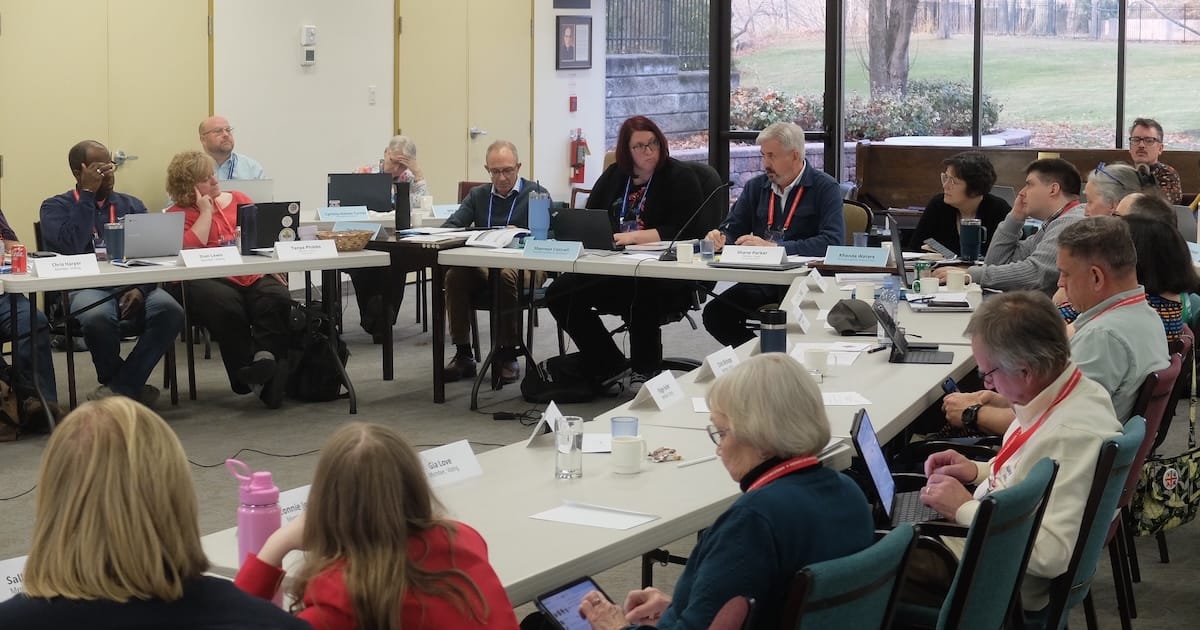
Members of the Council of the General Synod (CoGS) gathered at the Queen of Apostles Renewal Centre in Mississauga, Ont. at 9 a.m. EST.
Opening Eucharist
Archbishop Shane Parker, Primate of the Anglican Church of Canada, presided at the opening Eucharist in the chapel. National Indigenous Anglican Archbishop Chris Harper delivered the homily.
Members took a break from 10:05 a.m. to 10:20 a.m.
Motion: Appointment of Treasurer
CoGS approved a motion appointing Beng Wee as Treasurer for the Anglican Church of Canada. With this appointment, the National Church returns to the preferred practice of separating the role of Chief Financial Officer from that of Treasurer. Amal Attia will continue to serve in the role of Chief Financial Officer.
Resolution
That the Council of the General Synod appoint Mr. Beng Wee as Treasurer.
Motion: Appointment of Chancellor
CoGS approved a motion to appoint George E.H. Cadman, K.C., as Chancellor of the General Synod as of January 1, 2026. He will succeed Canon Clare Burns, who will step down at the end of the year.
Resolution
That the Council of the General Synod appoint George E.H. Cadman, K.C. as Chancellor as of January 1, 2026.
Tracking (Part 1)
The Primate drew council’s attention to a tracking document representing deliverables, or tasks, assigned to CoGS from General Synod. The summary listed resolutions carried at General Synod and directing or requesting CoGS to take action; motions not carried, but referred to CoGS; and other resolutions carried, which CoGS will monitor via the Tracking agenda item.
Primate’s remarks
The Primate said CoGS was standing on a platform consisting of three pillars. The first pillar is property, including both its current building at 80 Hayden Street in Toronto, which houses the national office of General Synod, also known as Church House; and the matter concerning a lease signed for 300 Bloor Street West, which would have meant shared national office space with the United Church of Canada and Presbyterian Church in Canada. The Primate described this pillar as “stable” in terms of options the church is exercising.
The second pillar comprises six “pathways” that a primatial commission identified for change in the church. These pathways concern:
- Organizational structure
- Management overview and restructuring
- Inclusivity and diversity in decision making
- Communications
- Walking in partnership with the Indigenous church
- Ministry in remote northern communities
The third pillar is Church House, specifically staff members. The Primate said the national office would be working with CoGS to enact the restructuring of Church House as soon as possible, taking into account its purpose, how it must be staffed and organized to achieve that purpose, and how the building itself serves that purpose.
A unique ministry of Church House, the Primate said, is enabling the episcopal ministry of the Primate to serve and enable unity among the people, clergy, parishes and dioceses of the Anglican Church of Canada. He described the national House of Bishops, which the Primate convenes and serves as pastor to, as an integral part of primatial ministry. The Primate said the House of Bishops is a very positive, cohesive group willing to engage in the task before the church. At its most recent meeting the house had considered the first, fifth and sixth pathways—resulting in some surprising differences of opinion, the Primate said, but also commonalities and questions that were heard without conflict. “It bodes well that the bishops of our church want to work well together,” he added.
Since becoming Primate in June, Archbishop Parker has travelled from coast to coast, visiting all four ecclesiastical provinces and many dioceses. He hopes to visit all 30 dioceses over the course of the 2025-2028 triennium.
In terms of relationships across the Anglican Communion, the Primate will attend the consecration of Archbishop Sarah Mullally as the new Archbishop of Canterbury and the Primates’ Meeting in March 2026. Touching on the Anglican Church of Canada’s full communion partnership with the Evangelical Lutheran Church in Canada, the Primate said he will attend the consecration of the Rev. Imad Haddad as the next bishop of the Evangelical Lutheran Church in Jordan and the Holy Land in January 2026.
Noting that he and his wife had recently taken up temporary residence in Toronto, while maintaining their small townhouse in Ottawa, the Primate said, “I am the Primate of all Canada and identify as a Canadian archbishop serving the Canadian church, and when I travel abroad I bring our beloved church wherever I am.”
Church House pillar
General Secretary Andrea Mann spoke about the Church House pillar. She highlighted the diversity of Church House staff, which includes employees of different ethnicities, genders and linguistic backgrounds; Indigenous and non-Indigenous; across a wide range of ages and experiences. Church House remains a hybrid workplace post-pandemic, with some staff working remotely. The General Secretary described General Synod staff as a “highly professional workforce” that includes accountants, writers, IT specialists, journalists, administrators, designers, clergy and lay people. “‘It is a community that brings deep commitment to the mission of church and deep care and compassion for one another,” she said.
While Church House staff have lived and adapted through various calls for restructuring over the years, the General Secretary said, the current moment feels different, with Church House in a state of heightened awareness. Many staff members are eager to move forward with the pathways; others are quietly anxious, concerned about their livelihoods. Across the board, however, there is a shared desire to be informed and genuinely included.
The team for pathway two, concerning management overview and restructuring—an area especially important to Church House, the General Secretary said—is now close to being fully formed. Almost all standing and coordinating committees have met.
Meanwhile, day-to-day ministry continues at Church House: governance, research, communications, welcoming visitors and guests, navigating relationships with donors, financial administration, and project continuation from the previous triennium, supporting the ministry and witness of the Anglican Church of Canada locally, nationally, and internationally. “Transformation is underway, but ministry has not paused,” the General Secretary said, noting every aspect of Church House would be examined by the pathways teams.
Some existing departments at Church House might disappear as Church House leans into rationalized integration and cost/benefit analysis for improved ministry, the General Secretary said. Staff numbers would continue to decrease, and work areas in the national office at 80 Hayden Street would change. The General Secretary said a foundation was being prepared for what came next, and the people who serve the national office at Church House were committed, engaged, hopeful, and stepping into 2026 with clarity and faith in opportunities for renewal.
Property pillar
Chancellor Clare Burns offered an update on the situation involving the lease signed for the General Synod to move to 300 Bloor Street West in Toronto. With the help of outside counsel, General Synod is currently in negotiations with the United Church to exit the lease. If negotiations get to the point where officers of General Synod can make recommendations, they will return to CoGS to seek approval. The United Church, Canon Burns said, was understanding of this process.
The Primate said while things are moving in a positive direction regarding 300 Bloor Street West, work to reorganize Church House—i.e. the people who work there—must happen before any programming plan can be made about how to use or monetize the national office at 80 Hayden Street. In response to a question from Archdeacon Jordan Haynie Ware, clergy member from the province of Northern Lights, the Primate confirmed that the Property Task Force assigned to navigate the property pillar would also be considering General Synod partners who reside at Church House. Partners such as the Anglican Foundation of Canada, the Primate said, are an “integral part of who we are.”
CoGS passed a motion approving terms of reference for the Property Task Force.
Resolution
That the Council of the General Synod approve the terms of reference for the Property Task Force as set out in the memo dated November 22, 2025.
Authority of CoGS
The Chancellor outlined the authority of council in the context of the national church in Canada, noting there is a wide range in how individual dioceses within the Anglican Church of Canada were established and how their canons operate.
Canon Burns said CoGS is not limited to discussing what the Primate and General Secretary think is important. If council collectively decides on a course of action it sees as necessary for the welfare of the church, it has the authority to offer advice to the Primate.
Members took a break for lunch from noon to 1:30 p.m.
Who’s in the Room
Archdeacon Rhonda Waters, co-chair of the Planning and Agenda Team, led council in an icebreaker activity for members to get to know each other.
Members lined up across the room and sorted themselves according to various criteria, such as how far they had travelled to attend CoGS, the decade in which each was born, and their desired pace for enacting changes across the church.
Roles, needs and expectations
CoGS members based on ecclesiastical province, along with Church House staff members and media, dispersed into table groups to discuss their respective roles at council, what was expected of them and their own needs.
Expectations included some common themes: attending CoGS meetings, being prepared, accountability, participation, asking questions and listening to others, and bringing forward concerns of those parts of the church each represented.
Table groups also identified common needs: open communication, space and time to learn and share ideas, allowing everyone to be heard equally, timely information, clear understanding of structures and mission, and prayers.
Members took a break from 3:15 to 3:30 p.m.
Process for discussion and decision making
CoGS learned more about the processes by which they would make decisions over the coming triennium. The Primate outlined the approach of consensus decision-making, with Waters presenting the green, yellow and blue cards members would use to vote.
Green cards mean a firm “Yes, I agree with this proposal”. Yellow cards mean “I don’t think this is the best, but it’s good enough” and indicate that a member is willing to along with the rest of the group. Blue cards mean “No, I do not support this proposal” and that council must keep working, with the member believing a better way forward is possible.
Messages from 2023-2025 CoGS
Archdeacon Tanya Phibbs, prolocutor to CoGS, invited members to share messages the last council in the 2023-2025 triennium had relayed as advice to their successors. Messages included “Don’t hesitate to ask questions or express your opinions,” “Trust God,” “We’re here because we love Christ’s church,” “Work can be hard, but also rewarding,” and “Open your heart to new ideas.”
The Primate led council in a prayer penned by his own immediate predecessor, interim primate Anne Germond.
Members took a break from 4:30 to 7 p.m. and ate supper.
Orientation Manual
Shannon Cottrell, executive secretary for governance, guided CoGS through the orientation manual for members.
The Primate said members should feel free to raise any opinions during discussions, noting that once council makes a decision, as CoGS members they must each represent that decision. Henrieta Paukov, director of Communications and Information Resources, reminded members that what happens at CoGS is reported extensively through the Anglican Journal (on anglicanjournal.com and in print) and the Anglican Church of Canada’s corporate communications (via anglican.ca).
General Synod 2025 debrief
Members watched a video of people attending General Synod 2025 in London, Ontario talking about their experiences. Deputy Prolocutor Brian Lee invited table groups to discuss and answer the question, “What were the highlights of General Synod 2025 for you?”
One table group highlighted the primatial election, feeling that the spirit of God was in place and a sense when the Primate-elect started speaking that General Synod had chosen the right person. Others pointed to the meeting of primatial candidates with youth delegates, synodical discussion with partners, transparency in debate on the property at 300 Bloor Street West, and “lunch and learn” educational sessions.
Members highlighted Alongside Hope detailing ongoing projects such as the “solar suitcases” program, which provides electricity to rural health clinics in East Africa; the work of the pastoral care team; approval of the pathways; General Synod expressing solidarity with people in the Holy Land; and beautiful worship space at St. Paul’s Cathedral.
Lee then asked table groups to discuss the question, “What did you find challenging about General Synod 2025?” Members noted the difficulty of some discussions, such as those regarding non-disclosure agreements and the lease at 300 Bloor Street West.
Some felt the schedule was overwhelming, leaving it hard to find time for personal peace at the end of the day. Others pointed to limited food accommodation for those with dietary restrictions; Bible study sometimes feeling rushed; needing more time for discussion, potentially through shorter videos and reports; and pushback youth delegates received on their motion calling for more names of primatial candidates.
Connie Jensen, lay member for the province of Northern Lights, said as a “100% rural person” who was not used to urban areas, she saw a challenge in the invisibility of people living on the streets of London that members passed as they moved from one venue to another, as at the same time General Synod was praying for people in other troubled areas of the world. “I kept wanting to see the body of synod addressing that somehow,” Jensen said.
Evening Prayer
The day ended with Compline evening prayer in the chapel.
Members enjoyed an evening social from 9 p.m. to 11 p.m.