
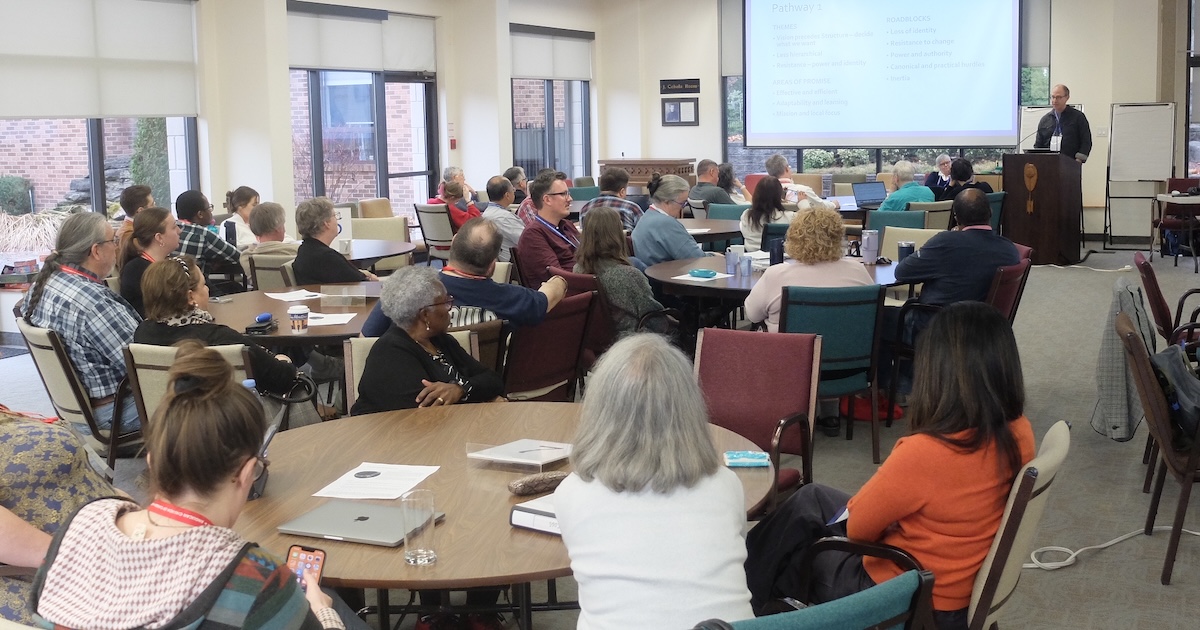
Members of the Council of the General Synod (CoGS) gathered at the Queen of Apostles Renewal Centre in Mississauga, Ont. at 9 a.m. EST.
Bible study
CoGS members read and discussed Isaiah 40:30-31, which describes how those who trust in God will find renewed strength.
Considering the Pathways
Andrew Stephens-Rennie and Canon Janet Marshall, co-chairs of the Transformation Task Force responsible for enacting the six pathways for change in the church, reported feedback from CoGS discussion on each the pathways, identifying themes, roadblocks, and areas of promise:
- Organizational structure. CoGS emphasized the need for vision to precede structure, insisting on setting clear missional goals before designing the institutional structures that support them. Members desired a less hierarchical structure—though transforming these structures may face resistance from Anglicans who fear losing power or identity, particularly from bishops. Areas of promise include making the church more effective and efficient, with more adaptable structures better suited to learning, mission and focusing on local ministry.
- Management overview and restructuring. Areas of promise include efficiency and clarity, reducing overload on staff and clarifying who does what and why, in a way that prioritizes the mission of the church. CoGS members aimed to increase accountability, build greater confidence in Church House and provide more focused communication on what General Synod is doing. Roadblocks might include disagreements over jurisdiction between national, provincial and diocesan levels of the church and how to navigate these disputes.
- Inclusivity and diversity in decision making. CoGS spoke about the need for authentic representation in governance—eliminating barriers to participation through strategic and systemic change, and moving beyond tokenism to diverse representation including youth, Indigenous people and Black Anglicans at all decision-making levels of the church. Areas of promise include starting with dioceses, recruiting through existing groups and congregations, and enhanced youth involvement. Roadblocks include financial and time burdens and linguistic differences that might prevent full participation.
- Communications. Areas of promise include using communications tools to foster connection and build relationships, creating an informed, engaged church body; and relational and invitational efforts reaching beyond the church, i.e. evangelism. Debate over the relationship between editorial independence and institutional alignment for the Anglican Journal is a potential roadblock.
- Walking in partnership with the Indigenous church. Themes CoGS highlighted include reconciliation through learning and listening, addressing settler responsibility, and concerns about momentum and process. Respect, listening and support of full communion partners are areas of promise. However, some members saw the 2028 deadline for enacting the pathways as a roadblock in this case. Others expressed concerns about a lack of awareness, both of the Truth and Reconciliation Commission of Canada (TRC) and what the church needs to do to live into the TRC’s 94 Calls to Action; lack of understanding of current church structures that this pathway needs to address; and loss of momentum over time.
- Ministry in remote northern communities. Areas of promise include broad support for northern ministry; opportunities for education on the realities of life and ministry in the north; and a widespread desire among northern Anglicans to be full, active participants in the life of the church. The scale of the challenge, given geographic and logistical barriers related to travel between small communities in the North, remains a roadblock, as does inequality in the form of an “us vs. them” mentality and risk of a patronizing, colonial approach to funding northern ministry.
Canon Marshall shared the responses of ecclesiastical province groups at CoGS to the question on things council needed to keep in mind: its reconciliation work, the people it is doing the work for, diverse people and contexts, Anglican Council of Indigenous Peoples (ACIP) leadership, the inherently challenging and complicated nature of pathways work; the need to be gentle, hopeful, encouraging, joyful, and to keep going; learning and understanding church structures; and building in expectation of resistance.
Provincial groups also spoke about the need for dioceses to be aware of the pathways; that the work needs to happen at all levels of the church, not just General Synod; to be aware of tensions between investment in community and protection of local identity; the need for engagement and dialogue to build understanding and acceptance, to cultivate healthy and trusting relationships, and to receive timely, thoughtful updates.
Members took a break from 10:30 to 10:45 a.m.
Tracking (Part 4)
General Secretary Andrea Mann continued guiding CoGS through the tracking list of deliverables to General Synod. Council voted to refer a motion modifying Canon III, which concerns the primacy, to the Governance Working Group.
Resolution
That this Council of the General Synod refer this examination to the Governance Working Group to prepare for further discussion at the June 2026 meeting of the Council of General Synod.
Further deliverables included the following motions not carried at General Synod, but referred to CoGS:
- Resolution C009: General Synod Spending Limit. Directs CoGS to consider a policy requiring officers of General Synod to obtain the consent of General Synod or CoGS prior to incurring any expenditure or financial commitment amounting to more than a “reasonable limit” set by CoGS for transactions not accounted for in the approved budget. CoGS accepted a recommendation to discuss C009 at a future meeting early in the 2025-2028 triennium, after the officers and Financial Management Committee prepare a proposal.
- Resolution C015: Youth Involvement on the Council of General Synod. Requests CoGS to consider a change to Section 33.a.vi of the Constitution of General Synod to allow for the election of two youth members per ecclesiastical province onto council. CoGS voted to address C015 at a future council meeting later in the triennium.
- Resolution C004: Universal Basic Income. Directs the Primate, on behalf of the Anglican Church of Canada, to write to the federal government and urge them to implement a universal basic income, unconditionally, in alignment with the living wage for all Canadians. Archbishop Shane Parker, Primate of the Anglican Church of Canada, said he would be happy to treat this as a motion and write such a letter if CoGS voted in favour of doing so, which it did.
- Resolution C005: Artificial Intelligence Use in the Church. Directs COGS to convene an artificial intelligence (AI) ethics task force to set guiding virtues that will help the church negotiate faithful engagement as generative artificial intelligence (genAI) technologies shift. Based on the Primate’s recommendation, CoGS voted to leave C005 to the General Secretary and staff to handle for the moment, seeing what conversations on AI are happening at theological colleges, within the legal community, etc. before deciding how council wishes to engage.
- Resolution C007: On the 1700th Anniversary of the Council of Nicaea. Reaffirms the enduring catholic doctrine set forth in the Nicene Creed and commits to work toward the Nicene vision of visible unity of the “one holy catholic and apostolic church” in Canada and around the world, especially by encouraging renewed ecumenical dialogue to restore a common computation of the date of Easter. Requests the Primate and director of Faith, Worship, and Ministry to ensure robust, active participation of Anglican Church of Canada representatives at the World Council of Churches’ Sixth World Conference on Faith and Order on the theme of “visible unity,” and at other events commemorating the anniversary. CoGS agreed to the Primate’s recommendation to let the process unfold as part of ongoing primatial work ensuring that interfaith and ecumenical work continues.
Discussion: C006-R1
Among motions not carried at General Synod but referred to CoGS, Resolution C006-R1: Use of Non-Disclosure and Non-Disparagement Agreements (NDAs) received its own session. Chancellor Clare Burns defined the two terms. Non-disclosure agreements (NDAs) are contractual agreements between one or more parties who agree to keep some set of facts confidential (e.g. the terms of a settlement agreement). Non-disclosure agreements are not legally enforceable if they seek to prevent a report to a police, regulatory or taxing authority.
Non-disparagement agreements, by comparison, are contractual agreements between one or more parties not to speak badly of one or more people or entities. For this purpose, “speech” includes oral or written statements, including all forms of social media. Non-disparagement agreements are probably not legally enforceable, the Chancellor said, but are included as a reminder of what is intended by a settlement. In response to a question from CoGS, the Chancellor said the acronym “NDA” only refers to non-disclosure agreements.
In table groups, CoGS members discussed two questions, the first of which was: “What information do you need to handle this resolution at a future date?” CoGS members identified the need to establish the main goal of the motion and who it aimed to protect, to know what has happened with this work already, and what information is available in dioceses to set a standard for this decision; and to look at the difference between confidentiality rules during an investigation and confidentiality of NDAs after an investigation.
One table group sought a description of problems Resolution C006-R1 might create if taken at face value, to troubleshoot the resolution and mitigate any potential issues. Another wondered how C006 fit into broader safe church thinking and principles of transparency, and whether any existing case studies might help shed light on different approaches to various scenarios. Council members asked about the distinction between NDAs used in employment matters compared to situations of harassment and abuse, noting that the latter are not always sexual; and whether insurance companies might dictate restrictions on what the church can or can’t do if it wishes to continue being insured.
The second question for table group discussion on C006-R1 was, “What do you see as the role of General Synod in this work?” Council members responded by the citing the need for General Synod and CoGS to gather context and intent and understand a wide degree of perspectives; to take the issue seriously in light of serious reputational risk; to model processes committed to not transmit suffering from generation to generation; and to set national standards and definitions of harassment that can be shared at the diocesan level. The Chancellor said the role of General Synod was to make sure it does not re-traumatize victims, and that it does not traumatize or re-traumatize bishops and chancellors who have suffered the vicarious trauma of doing this work.
Members broke for lunch from noon to 1:30 p.m.
Tracking cont.
The General Secretary presented another motion not considered by General Synod but referred to CoGS—Resolution C008: Opposition to Christian Nationalism. The Primate noted that Resolution C008 as written did not define the term “Christian nationalism” (although the background notes did).
A proposed motion condemning Christian nationalism prompted debate among CoGS members. Bishop of Qu’Appelle Helen Kennedy, member for the province of Northern Lights, asked if CoGS might instead vote on a statement focused on the Anglican Church of Canada’s stances on secularism and inclusion. The Primate suggested that the General Secretary and Ryan Weston, lead animator of Public Witness for Social and Ecological Justice, prepare a new motion based on background information and statements in the existing motion and bring it back to CoGS later in the meeting, which council agreed to.
The General Secretary noted 12 further resolutions carried at General Synod, which CoGS would monitor via the tracking agenda item. Some of this work had already been completed, while other work was ongoing and had been picked up by staff committees.
Change management
The Primate presented a document on change management, noting that while the church is facing major change, it has not developed many resources on how to manage organizational change. The Primate drew upon the eight-step model for guiding change developed by John Kotter and Dan Cohen based on decades of study. Kotter and Cohen, he said, found that organizations able to effectively change tended to go through eight steps in three different phases.
The first phase involves creating the climate for change:
- Create urgency
- Form a powerful coalition
- Create a vision for change
The second phase involves engaging and enabling the organization:
- Communicate the vision
- Empower action
- Create quick wins
The third phase involves implementing and sustaining the change:
- Build on the change
- Make it stick
Archdeacon Jordan Haynie Ware, member for the province of Northern Lights, noted in response to the eight-step model—particularly the idea of having a vision—that while the pathways had clarified what the Anglican Church of Canada needed to work on, the church still needed to determine what success would look like for each of those priorities.
The Primate outlined strategies for responding to common causes of resistance to change, such as people believing their needs are being met already, that change will fail, or that the costs of change outweigh the benefits. He noted that resistance can provide important insights and that those who resist are deserving of respect. These strategies include listening to people’s concerns, determining whether their views are based on accurate information, and asking them for suggestions on to make the change work better.
Partner reflection
The Rev. Chris Bishopp, representative of the Evangelical Lutheran Church in Canada (ELCIC) to CoGS, expressed his pleasure at having attended General Synod in June as a guest of the Anglican Church of Canada. General Synod had made good decisions and invested in great leadership, he said, impressed by the process of their electing what he considered a great Primate. The ELCIC had gone through a similar leadership process over the summer, Bishopp noted, electing the Rev. Larry Kochendorfer as its new presiding bishop.
Like the Anglican Church of Canada, the ELCIC has embarked on a sweeping process of change, Bishopp said, though Lutherans are further behind and still in the infancy of the process. The ELCIC has formed a steering committee, Facing Today—Dreaming for the Future, to lead a three-year project aimed at changing the church’s national and synodical structures, hiring consultants including Canon (lay) Ian Alexander, former prolocutor and interim general secretary for the Anglican Church of Canada.
Bishopp commended CoGS for being at the precipice of taking action to change the Anglican Church of Canada through the pathways, and said the ELCIC would be praying for them. “Your witness and your expression of the church deeply matter to us at every step along the way,” he said.
Members took a sabbath period for rest from 3:20 to 5:30 p.m., followed by a banquet dinner until 7 p.m.
Draft statement on Christian Nationalism
CoGS read the draft statement on Christian nationalism, which the statement called a growing threat to the Anglican Church of Canada’s values of inclusion and Canada’s commitment to religious pluralism. The statement described Christian nationalism as an ideology that “seeks to merge Christian and Canadian identities, conflating them and distorting both Christian faith and Canada’s parliamentary democracy. Christian nationalism demands that Christianity be privileged by the state and implies that to be a good Canadian, one must be Christian.”
Christian nationalism, the statement said, can provide cover for discrimination against marginalized groups and increase threats and violence against religious communities both at home and abroad. “In that light,” it said, “we denounce Christian nationalism as a distortion of the gospel of Jesus and a threat to Canadian democracy.” Council unanimously voted to endorse the statement. The Primate said the statement will be disseminated by the Communications department.
Roles, needs and expectations (Part 2)
Archdeacon Rhonda Waters, co-chair of the Planning and Agenda Team, presented a summary of expectations and needs for voting members of CoGS, partners, media and Church House staff, based on Nov. 27 table group discussions.
Voting members of CoGS are expected to prepare by checking their email between and during in-person meetings, reading materials that are provided, and taking responsibility to learn what they need to learn. They should participate by speaking up and sharing their thoughts, asking questions and being curious, being open to the Spirit to engage in discernment with one another, and be collaborative and creative as well as mutually accountable to one another. As representatives of their dioceses, ecclesiastical provinces, and in some cases youth or ACIP, they are expected to bring their own contexts and identities into the room and connect CoGS back to those contexts.
In turn, voting members need personal support in the form of space and time to learn, adequate rest and self-care time, food and refreshments, recognition and appreciation, and time for prayer. They need structural support through clear communication; contact information; clear understanding of the structure, mission and role of CoGS; and funding and other resources for work asked of them. Community support is also vital through opportunities to connect with other members, to be heard equally and share their ideas, a sense of humour and recognition that we belong to God and so does our work.
Partners such as non-voting agency representatives, chaplains, the Transformation Task Force, and Planning and Agenda Team co-chairs, are expected to encourage, gather, listen and learn; to strengthen relationship between agencies and groups, provide institutional memory, facilitate prayer and spiritual care, provide support in reading the Spirit and feelings in the room; and to link CoGS, the Transformation Task Force and the pathways. To meet these expectations, partners need honest engagement and for people to bring their whole selves, have trust and extend grace.
Members of the media attending CoGS are expected to listen for what’s important to readers and Anglicans at home; to discern what is reported and how soon; to be inquisitive, polite, respectful observers; and to be impartial and accurate in their reporting. To meet these expectations, media need access to the room and CoGS members for follow-up questions; to have access to Wi-fi, and to be understood.
Church House staff members are expected to attend CoGS, providing consultation, communication, advocacy, governance and administration; to be accountable for and transparent in their work; to provide accurate reports, engage in discussion, make decisions when appropriate, and understand their roles and responsibilities as non-voting members. To meet these expectations, Church House staff need CoGS members to understand what they can expect of staff, to read their reports and come prepared for discussions; to hear from members regarding what they are experiencing in their home communities, parishes, dioceses and provinces; and to pray and be prayed for.
Evening Prayer
Members closed the day with prayer in the chapel.
An evening social took place until 11 p.m.