
VIew a PDF version of Highlights from the Council of General Synod: November 9, 2024.
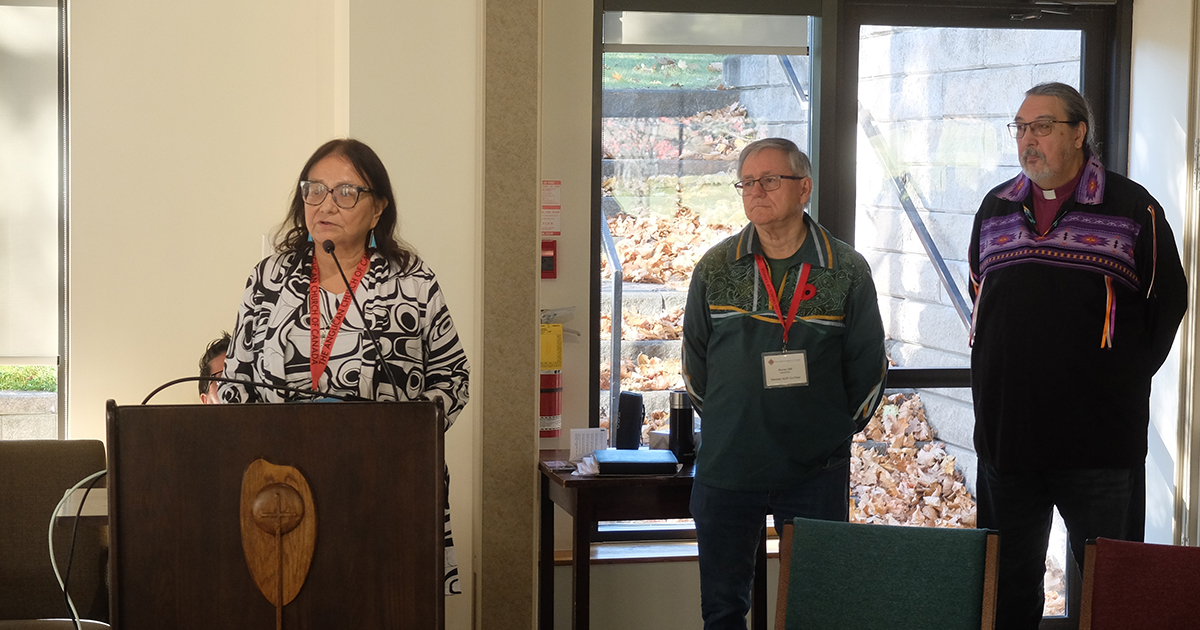
Members of Council of General Synod (CoGS) gathered at 9 a.m. in the Queen of Apostles Renewal Centre in Mississauga, Ont.
Gospel-Based Discipleship
CoGS read and reflected upon Luke 15:1-10, in which Jesus tells the parables of the lost sheep and the lost coin.
Anglican Council of Indigenous Peoples
The report from the Anglican Council of Indigenous Peoples (ACIP) began with a video that highlighted a quote from late Indigenous Ministries coordinator the Rev. Canon Ginny Doctor on the Indigenous journey to self-determination. The video detailed the history of Sacred Circle, its most recent meeting in 2023, ratification of the Covenant and Our Way of Life, and the Indigenous youth gathering Sacred Beginnings. The Ven. Rosalyn Elm, Canon Doctor’s successor as Director of Indigenous Ministries, said the video showed the strength of their people, but that much work remained to be done on the ground.
Over the last few months, Archdeacon Elm said, Indigenous Ministries has been overhauling its website with the support of Communications and Information Resources, deciding what to keep and what not to, as well as creating a social media plan. She described a sense of excitement at using all these platforms in a meaningful and sacred way. Indigenous Ministries is also looking deeper into its administration and policy. One example has been progress on a standard procedure document that brings Indigenous approaches, such as incorporating talking circles, into their work.
Indigenous Ministries has also been expanding into mission and ministry, in some cases partnering with Alongside Hope and the Anglican Foundation of Canada. An area it hopes to provide support for is men’s mental health, which is often underserved in Indigenous communities, as well as bolstering peer support for youth. Education is also a major focus, with Indigenous Ministries planning to outline a program in the new year for education and conversations in communities that seek to support and nurture feelings of self-worth. Archdeacon Elm said Indigenous Ministries are also putting forward policies and procedures for budgets and budget reporting.
Rosie Jane Tailfeathers, co-chair of ACIP, spoke briefly about her background as a residential school survivor. She said ACIP had decided to have members at large and guest speakers at large as part of their committee processes, ACIP members and other members from the worldwide church, as well as Indigenous peoples. ACIP intended to listen and learn from all those who can help them on their journey to speak better for the future. “People have spoken for us in the past,” Tailfeathers said. “Now it’s our turn to speak for ourselves as Indigenous people.”
The Rev. Canon Murray Still, co-chair of ACIP, said a key question going forward was how to live and work together to strengthen identities as both Anglicans and Indigenous Anglicans. This question informed the Covenant and Our Way of Life, which he called a living document. “Every time a Sacred Circle is called, we get a chance to look into those things and continue to see what our governance looks like,” Canon Still said. Planning is currently underway for the next Sacred Circle, with ACIP set the following week to discuss aspects such as location costs, preliminary email drafts for invitations, and thematic aspects. The tentative plan is to hold Sacred Circle in early May 2025.
Youth work is another focus, with support from Alongside Hope. ACIP plans for Sacred Beginnings to continue as a regular youth gathering. Canon Still noted the recent death of Justice Murray Sinclair, who served as chair of the Truth and Reconciliation Commission of Canada (TRC), and said ACIP grieves and mourns his loss. Among the results of TRC gatherings over five years were the 94 Calls to Action, which the Anglican Church of Canada is part of. ACIP members have taken part in an engagement with the Primate’s Commission on Re-Imagining the Church and offered their thoughts.
National Indigenous Anglican Archbishop Chris Harper shared photos from his travels across the country, adding that he was blessed to travel and be with bishops across the church in the ministry they share together. In finding a common voice, Archbishop Harper said, Indigenous Ministries strove to be part of the DNA of the Anglican Church of Canada and to play an integral role—not separated or as a guest, but as part of the family. He recalled the experience of the 2023 Assembly, in which Indigenous Anglicans brought in the round dance and members of General Synod and the National Church Council of the Evangelical Lutheran Church in Canada joined in dance together.
Indigenous people have survived and are not going anywhere, Harper said, bringing with them the strength of their ancestors. He noted that in his travels that year, he had sometimes been invited with questions like, “Would you bring your feathers and drums and come and sing and dance for us at our next meeting?” He had heard people say, “We don’t have Indigenous people in our diocese,” and responded, “Really? Have you looked out in the pews?” The National Indigenous Archbishop believed the church could do better and is better in finding the road to peace and healing, finding evidence in the “amazing ministries in all the churches I’ve been to.”
“We will do better,” Archbishop Harper said to CoGS. “I believe in that, because I believe in you. And I believe because I see the eyes of Christ in yours.” Following the ACIP presentation, Archbishop and Acting Primate Anne Germond confirmed that two ACIP members had been appointed to the Primate’s Commission on Reimagining the Church: the Rev. Rod BrantFrancis and the Rev. Vincent Solomon.
Members broke for coffee from 10 a.m. to 10:30 a.m.
Governance Working Group
Chancellor Canon Clare Burns provided an update on the work of the Governance Working Group (GWG). She noted the withdrawal of resolutions including amendments to Section 11 of the Declaration of Principles, as well as Resolution A030-R1. The latter was a response to Resolution C009 passed at General Synod 2019, which would eliminate the need for approval of changes to certain canons by two successive sessions of General Synod.
She brought council’s attention to Resolution C009 referred from General Synod 2023, which directed CoGS to determine what would be necessary to implement a consensus model of decision-making for future General Synod meetings. In studying this resolution, the GWG had identified a number of words clarifying what consensus decision-making means: collaboration, egalitarianism, inclusion, participation, flexibility, active listening.
The chancellor asked CoGS to discuss four questions:
- What changes should be made to pre-synod meetings to better reflect consensus decision-making?
- What use could be made of our time as the Committee of the Whole to engage in consensus decision-making?
- What other suggestions does CoGS have as to changes that could be made to General Synod to better reflect the hallmarks of consensus decision-making?
- What other changes might be implemented at General Synod 2025 to better engage members?
Table groups each focused on one of the questions. In their responses, council members suggested that pre-synod meetings could incorporate simple lessons on “What is consensus decision-making?” and allow members to practice before General Synod. The Rev. Chris Bishopp, representative to CoGS from the Evangelical Lutheran Church in Canada, said when discussing contentious issues, Lutherans will often first take time in smaller groups to exchange their individual feelings and opinions. Listening to neighbours, he said, tends to de-escalate opposition heading into larger discussions.
CoGS members said General Synod might benefit from having live translation services for attendees who do not speak English as a first language, as well as potentially reconsidering time limits on speech, since different cultures can have different paces of discourse. One table said it was important to discern when to use consensus decision-making and when not to. Rosie Jane Tailfeathers recalled how many Indigenous peoples such as her own Blackfoot community use consensus decision-making, with everyone getting a chance to talk. Another table thought General Synod might benefit from rooting the language of deciding cards in shared community values, such as the five transformational commitments.
Canon Burns shifted discussion to another resolution referred from General Synod 2023: Resolution C012, which directed council to revise the process by which members of CoGS are elected by ecclesiastical provinces at meetings of General Synod. She presented five more questions to CoGS:
- What are the barriers to getting nominees to agree to stand for CoGS membership [time, cost, travel, what else]?
- Should we drop the rule related to each province’s members having to come from different dioceses by order?
- Should we establish a system of appointment by rotation?
- Should the dioceses be asked to amend their rules such that election to be a member of General Synod includes a requirement to be a member of CoGS if elected?
- Should we engage in a review of the size and composition of CoGS as part of broader work considering the structures of the church?
Table groups again each discussed one of the questions before presenting their responses to plenary. The idea of appointment to CoGS by rotation drew concern that it would lead to random selection, which members doubted was the best approach. Amending diocesan rules to require elected General Synod members to also serve on CoGS similarly raised concerns that this might shrink the breadth of representation.
Besides time, cost and travel, members saw other barriers to people agreeing to serve on CoGS as a lack of interest in church governance, compared to other aspects of church life such as developing prayers or organizing soup kitchens. Meanwhile, two table groups both said the current size and composition of CoGS made sense for the moment. The chancellor thanked council for their responses and said the GWG would incorporate their feedback.
2023-2025 CoGS Deliverables
The General Secretary the Ven. Alan Perry provided updates on each of the deliverables the last General Synod had asked of CoGS in the 2023-2025 biennium.
- A101—Commissioning a Document on History, Structure, and Governance of the Anglican Church of Canada. Status: Still in formation.
- A120—Full Communion with the Moravians. What are the implications for CoGS as we begin to live into this new relationship? Status: Question is still there.
- A129—National coordination committee for unity and mission with United Church. Work with the United Church to establish this group. Status: Group formed, starting work.
- A200—National Advisory Council on Dismantling Racism. Status: Group established, getting going.
- A201—Dismantling Racism. This is the work of Faith, Worship and Ministry and the National Advisory Council for Dismantling Racism. Status: Ongoing.
- A202—Call to Action 59. Call to Action #59 of the Truth and Reconciliation Commission of Canada calls on “church parties to the Settlement Agreement to develop ongoing education strategies to ensure that their respective congregations learn about their church’s role in colonization, the history and legacy of residential schools, and why apologies to former residential school students, their families, and communities were necessary. Status: Ongoing.
- A202A—Dismantling Racism. “[E]ngage with the full historical realities of the Anglican Church’s involvement in slavery, and other forms of racial injustice, as well as its historical work in striving to dismantle racism.” Status: Ongoing.
- A203—Net-zero – travel and offset costs. “[S]eek to reduce the carbon impact of travel for meetings of General Synod, the Council of General Synod, and its committees, when possible, by offering online or hybrid options and choosing lower-carbon travel as a witness to the rest of the Church, and to report on these efforts regularly and to General Synod 2025.” “[P]urchase carbon offsets for such travel as is deemed still to be necessary, using offset initiatives of Indigenous communities where possible.” Status: Ongoing.
- A204—Climate Emergency. “Encourage Anglican parishes in Canada to work on reducing greenhouse gas emissions to help Canada reach a science-based target to keep global temperature increases at or below 1.5 degrees Celsius.” Status: What’s happening in your parish/diocese? “Request the Public Witness for Social and Ecological Justice Coordinating Committee to report progress back to the Council of General Synod annually and to General Synod 2025.”
- A205—Bottled Water. “Direct the Council of General Synod, its Councils, and Committees to immediately eliminate bottled water use for all meetings, except in locations where safe drinking water is unavailable.” Status: Implemented.
- C008—”Request the House of Bishops engage in a discussion regarding the principle of proportionality of membership, as reflected in the Constitution of General Synod for the membership in the Orders of Laity and Clergy, and to recommend a method for applying this principle to the Order of Bishops for consideration by the Governance Working Group and the Council of General Synod, in advance of the next meeting of General Synod.” Status: Discussions in progress.
Members broke for lunch from noon to 1:30 p.m.
Black Anglicans of Canada
Dr. Ryan Weston, lead animator of Public Witness for Social and Ecological Justice, introduced the report on the first national conference of Black Anglicans of Canada (BlAC): the Disrupt, Heal, Lead Conference, which took place from Aug. 14-17 at St. John’s College, University of Manitoba in Winnipeg and was supported by money from the Ministry Investment Fund.
Jacqueline St. Kitts, lead consultant for the gathering, shared highlights from the event. A key moment was its honouring of the life and legacy of the late Rev. Romney Moseley, a scholar of divinity who wrote a report to General Synod in 1992 that would serve as the foundation for the Anglican Church of Canada’s policy on multiculturalism. St. Kitts shared a declaration from BlAC, which stated: “We as people of African Descent are commissioned and called to be ambassadors of reconciliation. We are called to create opportunities and space for building, healing, fellowship and empowerment.” She believed BlAC had accomplished this at the event.
St. Kitts outlined accomplishments of BlAC to date, which included appointing new directors in January 2024, re-establishing a website in May 2024, rebranding and increasing engagement over the past year (e.g. through a Thursday morning prayer and evening Bible study), and holding the national conference in Winnipeg, which she said provided reinvigorated energy to move forward with its work. BlAC planned to seek opportunities for future funding and sustainability.
The Disrupt, Heal, Lead Conference brought together approximately 40 attendees, including all speakers, guests and volunteers. Nine speakers from across Canada presented on a range of topics, including Black Anglican history, decolonization and the Bible, the experiences of Black clergywomen and lay leaders; and African language, identity and culture in the context of Canadian church and society. The conference raised $1,405 in total to continue the work of BlAC.
Attendees reported high satisfaction with the content of the sessions and speakers and presenters were well-received, St. Kitts said. Future gatherings organized by BlAC will include a discussion series in December and upcoming gatherings in November 2024, February 2025 and May 2025. St. Kitts noted that costs for the event came under its $35,000 budget, at $33,500, leaving funds for future activities.
The Rev. Wilson Akinwale, national president and board chair of BlAC, also spoke on the conference, which included a visit from ELCIC National Bishop Susan Johnson and remarks from Uzoma Asagwara—Manitoba’s minister of health, seniors and long-term care, one of the first Black MLAs in Manitoba history, its first non-binary MLA and a lifelong Anglican. Akinwale reiterated that BlAC is looking to see how to leverage its finances for the future, as well as looking to see how it can partner more with its Lutheran siblings. “We believe we are building a formidable leadership, Anglicans and Lutherans together, for future generations,” he said.
The Acting Primate invited questions and comments from CoGS. Archdeacon Victor-David Mbuyi Bipungu, hailing from the diocese of Montreal and originally from Congo, thanked St. Kitts and Akinwale for their presentation and said it was helpful to know what they were doing. Canon Still invited BlAC to consider ACIP as a resource and said he was happy to chat more about how the Black and Indigenous Anglican groups could work together.
Council of the North
Bishop of Caledonia the Rt. Rev. David Lehmann, chair of the Council of the North (CotN), and Bishop of Yukon the Rt. Rev. Lesley Wheeler-Dame, appearing via Zoom from Edmonton, presented an update on the council representing northern dioceses. Bishop Wheeler-Dame, a member of the Grant Allocation Committee of the CotN since 2019, spoke about how the Block Grant from the General Synod funds much of the CotN ministry, with the committee deciding how the grant is divided up.
In 2023, Bishop Wheeler-Dame said, the Block Grant began to be reduced by $100,000 each year, which will continue until it reaches 25% of the proportional giving of each diocese. “It is a little bit concerning, a little bit alarming,” she said. Cost of travel and accommodations is high in the north. While there is not a groundswell of money available, she wished to share a story about what happens in northern parishes that is not reflected in official statistics.
Following a suicide in the fly-in community of Old Crow, Yukon, Bishop Wheeler-Dame travelled there to be with the community and did five different prayer services. At the time, there were tensions in the community because of the ways some family members wanted to deal with cremation. Despite her training as a social worker and in psychology, Bishop Wheeler-Dame said, she knew the only thing that would help was prayer. She told someone she was going on a prayer walk, stretching 6 km across the whole community. She began walking, the other person walked with her, and soon they noticed a few others had joined. In the end, they had 50 people walking behind them, praying for the community.
“Those are the kinds of things that the statistics don’t show us,” Bishop Wheeler-Dame said. Statistics tend to track only attendance numbers at regular Sunday services, which can make it difficult to show the need to fund other kinds of ministry. Bishop Lehmann said CotN is grateful for the funds it receives. Besides the Block Grant, these include other sources such as donations from Anglican Church Women (ACW) groups, administered by the Anglican Foundation of Canada (AFC), to help support retired clergy, as well as Giving With Grace.
Bishop Lehmann said the biggest thing the CotN can ask for, aside from finances needed to carry out ministry in small communities that are often hard to access, are prayers from the church. The CotN is ministry by the whole Anglican Church of Canada, he said. He shared other good news stories from the North, such as St. Matthew’s Anglican Cathedral in Timmins, B.C. starting a lunch program that provides meals for homeless people in the downtown core.
Following the CotN report, Bishop of Qu’Appelle the Rt. Rev. Helen Kennedy thanked CotN and asked if there was any way to reverse the annual funding reduction of $100,000 and increase funding, particularly given the importance of Northern Canada as a field of ministry for the church. Scott Brubacher, executive director of the AFC, noted that the ACW CotN fund for retired clergy started with a grant of $100,000 from ACW New Westminster. The fund currently has about $270,000.
Members broke for coffee from 2:40 p.m. to 3:10 p.m.
Communications Committee
The Rev. Cynthia Haines-Turner presented the report from the Communications Committee. The Strategic Planning Working Group and Primate’s Commission has identified three functions of General Synod, known as the 3 Cs: Convening, Connecting, Communicating. The Communications Plan for 2025, she said, had been developed in light of the five transformational commitments, the mission statement of General Synod and the 3 Cs.
Hypothesis #7 from the Primate’s Commission states: “It is time to end independent editorial journalism funded by General Synod.” Many people across the country remain deeply attached to the Anglican Journal, Haines-Turner said, as seen in letters to the editor. Discussions in the Communications Committee started with the editorial position of the Journal: to serve as a journalistic enterprise which seeks to hold up a mirror to the church. Haines-Turner posed the following questions to CoGS:
- Is the editorial pos