
The Highlights now have a new, more concise format, so readers can easily find and follow the Council of the General Synod’s (CoGS) decisions. Questions and feedback are welcome at [email protected].
CoGS members gathered at the Queen of Apostles Renewal Centre in Mississauga, Ont., for the first day of a three-day meeting.
At a glance
- The Primate reflected on how the church is changing, including a smaller, more focused national office.
- CoGS appointed Dez Nacario as General Synod Archivist.
- Much of the day focused on the six pathways for renewing the church’s national structures, with updates from the Transformation Task Force and each pathway team.
- The Primate and the Governance Working Group outlined work ahead to prepare for electing the next Primate, such as a transition plan and options on residency and salary.
- CoGS approved the first members of the National Youth Council, a new body giving young people a voice at the national level of the Church.
Opening worship and business
The day began with prayer. CoGS then reviewed its mandate and the needs and expectations members set at the start of the triennium, the three-year period between meetings of the General Synod.
Primate’s opening remarks
Archbishop Shane Parker, Primate of the Anglican Church of Canada, marked the midpoint of the triennium by reviewing the changes underway in the church and the preparations needed for the years ahead.
Among those changes, he offered an update on the church’s national office at 80 Hayden Street in Toronto, known as Church House, which aims to become self-financing through lease revenues from commercial tenants. This would allow more money to remain in dioceses and parishes for ministry at the local level, the Primate said. With a smaller staff, Church House is now focused on two broad areas: relational work across the church and beyond; and core functions such as supporting synodical business (General Synod, CoGS, and related bodies), communications, finance, and archives.
The Primate also noted the establishment of the Office of Sacred Circle and reiterated his commitment to substantially revising Canon XXII, the church law on national Indigenous ministry, so it honours and lifts up The Covenant and Our Way of Life as guiding documents for Sacred Circle. He reminded CoGS of the General Synod’s five transformational commitments and that all the transformational work being done is geared towards the overarching goal “to invite and deepen life in Christ.”
Looking ahead, the Primate said the church needs to prepare for electing the 16th Primate at General Synod 2028 in St. John’s, N.L.
General secretary’s remarks and tracking overview
General Secretary Andrea Mann noted that CoGS is 17 months into the triennium, with 17 to go. Of the 28 items of work that General Synod 2025 referred to CoGS, eight are complete and the rest are in progress, she said, with some set to come before CoGS later in the meeting.
The general secretary also brought forward a recommendation to appoint Dez Nacario as General Synod Archivist, the role responsible for the national church’s historical records.
Motion: Appointment of General Synod Archivist
That the Council of the General Synod appoint Dez Nacario as General Synod Archivist as of January 4, 2027. CARRIED
Transformation Task Force overview
Much of the day was devoted to the work of the Transformation Task Force (TTF) and the six pathways for transformation it oversees. TTF co-chairs Canon Janet Marshall and Canon Andrew Stephens-Rennie opened with an overview of progress so far. In September, pathway chairs met to look at where the pathways intersect and created a shared timeline mapping each pathway’s work leading up to General Synod 2028. To support these efforts, the TTF’s 2027 budget includes a project manager and a program associate.
The task force will next gather in person in Winnipeg, Man., on Nov. 11-12.
Walking together in partnership (Pathway 5)
Archdeacon Travis Enright, co-chair of the Anglican Council of Indigenous Peoples (ACIP), and Archdeacon Rosalyn Elm, director of the Office of Sacred Circle, presented an update on Pathway 5. Enright said ACIP could adopt a new system for Sacred Circle representation as early as mid-2027. It would be based on regional council fires, which follow historical nations, linguistic areas and land and water territories.
Their report described work ahead on “Protocols of Relationship” to guide the partnership between the Indigenous and non-Indigenous church. Partners would come together as relatives, not rivals, with the Protocols adapted locally to fit each community’s people and land.
Bible study
Archdeacon Cheryl Palmer, chaplain to CoGS, led Bible study on Luke 16:9-15.
Management overview and restructuring (Pathway 2)
Zach Groves, lay member for B.C. and Yukon, presented an update from the pathway team. A survey of Church House staff found they were committed to the mission and felt supported by colleagues and leadership. Staff also identified areas to improve, such as communication between departments, approval processes and IT support.
With a smaller staff, Church House is now focused on its core work. For requests beyond that, the team is recommending a “project-based approach,” where groups championing new work prepare a brief with a clear scope, funding and end point. The approach would be shared at General Synod 2028.
In response to the staff survey, Church House leadership is reviewing requests for training, tools, communications and collaboration.
Inclusion and diversity in decision-making (Pathway 3)
The Very Rev. Dr. Carmen Lansdowne, consultant and co-lead on the Pathway 3 team and past moderator of The United Church of Canada, presented a report on General Synod governance. Prepared with fellow consultant and team co-lead Adele Halliday, it includes a structural audit and a roadmap for equity-centred transformation of church structures.
A key finding was that barriers to participation may begin at the diocesan level, given that General Synod members are chosen through diocesan processes that the General Synod does not control. Recommendations include widening eligibility, making nominations and staff hiring open and transparent, building equity into church law and making accessibility a funded priority. The report also recommends reviewing human resources and volunteer policies with an equity lens.
Planning for the next Primate
At General Synod 2025, members asked CoGS to consider a proposed change to church law. It concerned the rule that a newly elected Primate must step down as bishop of their diocese and, if they hold the role, as archbishop of their province.
Chancellor George Cadman, who chairs the Governance Working Group, said the group found that current church law already allows enough flexibility, so no changes are needed before 2028. For example, a new Primate does not have to be installed right after the election or move to Toronto, though they must keep an office at Church House.
The group will keep working on transition plans, salary ranges and accommodation costs, with options expected at CoGS by spring 2027.
Communications (Pathway 4)
Jamie Tomlinson, chair of the Communications Coordinating Committee/Pathway 4 team, and Henrieta Paukov, the national church’s communications director, gave an update on putting the new communications mandate into practice, including a refreshed print layout and new features in the Anglican Journal. A strategic communications plan is expected at CoGS in May 2027.
CoGS also approved the committee’s revised terms of reference, which bring its role in line with the new mandate.
Motion: Revised Communications Committee Terms of Reference
Be it resolved that the Council of the General Synod approve the revised terms of reference for the National Communications Committee. CARRIED
Governance structure (Pathway 1)
Archdeacon Rhonda Waters presented an update from the Pathway 1 team, which has refined its scope from the original pathways report to three areas:
- Dioceses and provinces: The team is focusing on encouraging collaboration and connection, since changes to the number or size of dioceses and provinces are beyond the General Synod’s authority.
- The meeting of the General Synod: Working with the Pathway 3 team, the team is looking at membership, format and decision-making to make meetings more accessible to a wider range of Anglicans.
- Committees and working groups: Working with the Pathway 2 and 3 teams, the team will propose smaller, more nimble structures for how the groups that carry out the General Synod’s work are created, supported and concluded.
The team expects to report to CoGS in spring 2027, then bring a proposal in fall 2027 for General Synod 2028, with some work expected to extend beyond 2028.
Ministry in northern communities (Pathway 6)
Bishop Clara Plamondon presented an update on behalf of the Pathway 6 team, which is re-examining the funding and role of the Council of the North, the group of northern dioceses that receive national funding. She said what began as administrative work has become an opportunity to reframe the Council of the North’s identity, moving beyond a group of dioceses seeking funds toward living into a shared vision for ministry.
While these dioceses feel stretched and under-resourced with limited staff, Plamondon described many examples of inspiring ministry across the north, such as one community where 30 baptisms took place. A number of diverse congregations are growing quickly in size.
The Pathway 6 team hopes to invite the Primate, the general secretary and metropolitans (archbishops of the church’s provinces) to spend a day at the next meeting of the national House of Bishops to discuss the relationship between the Council of the North and the General Synod and its long-term sustainability. Rather than a memorandum of understanding, she said, the team favours exploring a “covenant” between the two.
National Youth Council
Archdeacon Lauren Schoeck, clergy member for the ecclesiastical province of the Northern Lights, presented the work of the committee that reviewed applications for the new National Youth Council (NYC). CoGS voted to approve the NYC’s first members. ACIP, which appoints two members to the youth council, named Julie-Ana Noe, Brianna Bursey.
Motion: Initial Appointments to National Youth Council
That the Council of the General Synod approve the following slate for the inaugural National Youth Council:
Two-year term
- Johonan (Andrew) Gomes
- Paige Keller
- Kit Nemeth
- Erin Simpson
- Sally Smith
- Kevin Toole
Three-year term
- Bemshima Denga
- Kateri Fage
- Zach Groves
- Georgina (Gia) Love
- Nicolas (Nic) Riscalas
- Noah Skinner
CARRIED
Note: The list of members in the original motion contained an error. The motion above reflects a correction CoGS approved on Saturday, Nov. 7.
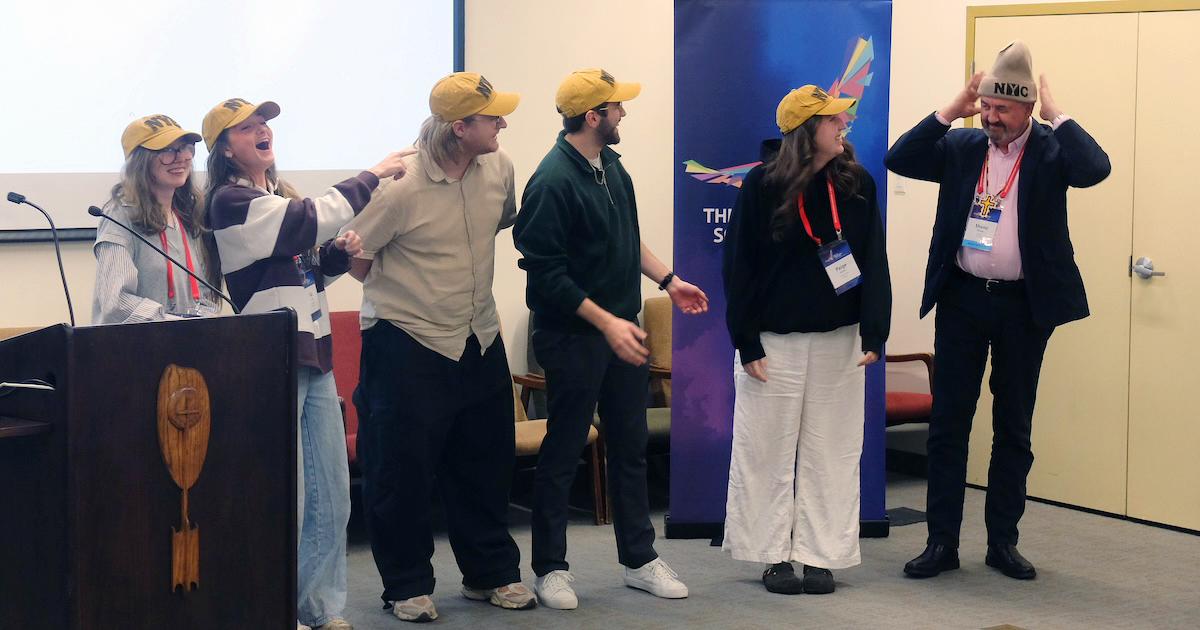
After the motion carried, the general secretary presented yellow “NYC” caps to youth council members at CoGS and a grey “NYC” toque to the Primate.
Evening prayer
The day’s agenda concluded with evening prayer in the chapel.
For more stories and detail from this meeting, watch for coverage from the Anglican Journal in the weeks ahead.