
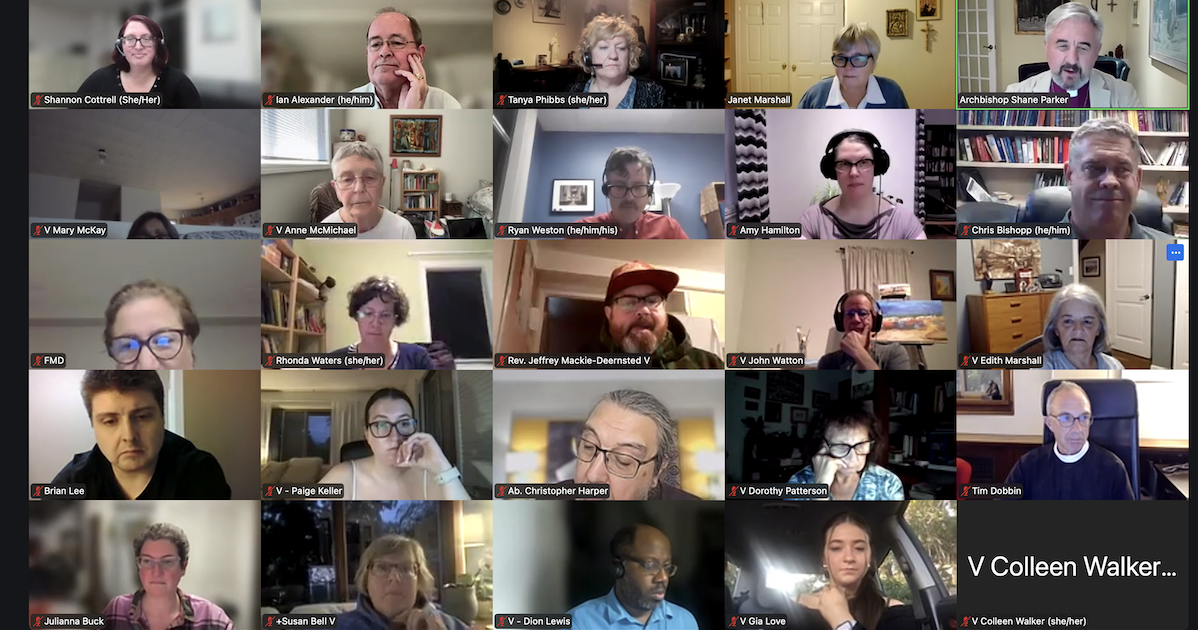
Members of the Council of the General Synod (CoGS) met online via Zoom at 7 p.m. ET.
Call to Order, Opening Prayer, Welcome, Opening Remarks
Archbishop Shane Parker, primate of the Anglican Church of Canada, welcomed CoGS members to the meeting and led opening prayers.
Primate’s nomination for General Secretary
Canon (lay) Ian Alexander, interim general secretary, outlined the process of nominating a new general secretary. The primate asked for the creation of a search committee, which advertised the position through the Anglican Church of Canada jobs board and received nine “credible” applications, Alexander said.
On the basis of a weighted scoring competencies matrix, the search committee shortlisted three of those applicants for Zoom interviews, which lasted over an hour each. The committee scored their impressions from the interviews based on standard questions. One candidate stood out from this process, Alexander said, and the search committee recommended this person to the primate as the new general secretary.
That standout applicant, Parker said, was Andrea Mann, the church’s Global Relations director. The primate described Mann as “a person of exceptional intelligence—wise, deeply pastoral and faithful,” who gave appropriate attention to detail while understanding dynamics of the larger picture. He said Mann was a team player closely aligned with where the church was at the time, who brought extensive experience and insight into both the Anglican Church of Canada and the worldwide Anglican Communion.
He commended her to CoGS for appointment as the new general secretary. CoGS unanimously approved a motion selecting Mann for the position.
Resolution
That the Council of the General Synod appoints Dr. Andrea Mann as General Secretary of the Anglican Church of Canada as of October 13, 2025 as nominated by the Primate and assisted by the Search Committee.
Mann thanked CoGS and said she was very moved by their confidence and support in her. The primate noted Mann would be both the first woman and first layperson to serve as general secretary of the Anglican Church of Canada.
Primate’s remarks
In his remarks to CoGS, the primate said the council had a specific task before it in the 2025-28 triennium. As primate, Parker said, he, CoGS and the officers of the General Synod stood on a “platform balanced on three pillars”. These pillars were:
- the six pathways for change recommended by a primatial commission over the next triennium;
- property—the location of Church House, the national office of the General Synod in Toronto, whether at its current location of 80 Hayden Street or the new location of 300 Bloor Street West church representatives signed a lease for; and
- people who staff program and operations at Church House.
Parker stressed the importance of ensuring the platform stays stable and not getting tipped too far into focusing on one or the other. CoGS, he said, would play an important role in this work. To manage the three pillars, Parker said, he would be establishing a primate’s council consisting of the officers of the General Synod, co-chairs of the Planning and Agenda Team, and the leads of those responsible for overseeing work of each pillar.
The pathways pillar, he said, will be managed by a Transformation Task Force as well as six pathways teams, each devoted to achieving the goals of their respective pathway. Any existing church body, committee, subcommittee, etc. that has anything to do with the six pathways will be co-opted into the pathways team to avoid parallel tracks.
The property pillar will be supported by a property task force chaired by engineer and architect David Caulfield, former chief architect of Public Works Canada. This team will include officers of General Synod and their lawyers, Parker said, and may shift its focus when the church’s national office confirms where it will be housed.
The Church House staff pillar will be overseen by the primate, general secretary, and senior staff of the General Synod. Parker said these staff members possessed considerable authority to shape Church House, and pointed to the need for a “tightly run general office that unambiguously serves the interests of the national church.”
Moving forwarded, Parker said, CoGS will be consulted and informed frequently about developments in managing work of the three pillars. In carrying out his own unique primatial ministry, he added, he planned to work from his desk at Church House most weeks of the year.
Canon Janet Marshall, the diocese of Toronto’s congregational development officer, laid out terms of reference for the Transformation Task Force, which she described as primarily a coordinating group that will manage, support and move forward the work of the pathways. Its members will be involved both in the task force itself and one of the pathways teams, which would be sorted out in the next month before the November meeting of CoGS. The task force also had the responsibility of consulting with CoGS to keep the latter informed and engage with council by seeking its advice, Marshall said.
CoGS voted in favour of motions to approve the terms of reference and membership for the Transformation Task Force.
Resolution
That the Council of the General Synod approve the Terms of Reference for the Transformation Task Force, and receive regular updates and meaningful input on the work at each of its meetings during this triennium.
Resolution
That the Council of the General Synod approve the proposed membership of the Transformation Task Force, including the listed CoGS appointees.
Motion for 4% investment funds withdrawal
Archdeacon Tanya Phibbs, prolocutor of the General Synod, said that in the 2025 General Synod budget, CoGS had approved the use of $350,000 from earnings of unrestricted investments towards operations, which at the time was thought an adequate amount to assist in General Synod operations that year.
However, in August and September, Phibbs said, the General Synod faced a cash-flow crunch—partly because of lagging proportional gifts from dioceses, and partly because of costs for meetings of the General Synod and Sacred Circle. Some of the latter would be remitted back from dioceses, she said, but that had not yet occurred.
As a result, treasurer and CFO Amal Attia had approached General Synod officers about taking more money from earnings on unrestricted funds. Phibbs presented the motion to withdraw up to 4% from unrestricted investment funds in the Consolidated Trust Fund (CTF) to allow the General Synod’s needs in 2025 to be met, including payroll and Council of the North funds. CoGS passed the motion.
Resolution
Be it resolved that this Council of the General Synod authorize the use of up to 4% of the value of the unrestricted portion of the Consolidated Trust Fund as of October 1, 2025 to support the operations of the General Synod in 2025.
NCTR development contribution
In autumn 2024, Andrea Mann said, the development team for the new National Centre for Truth and Reconciliation (NCTR) approached the Anglican Church of Canada, Presbyterian Church in Canada and United Church of Canada to request funds towards the building of a new centre that would be built in Winnipeg. Through the general secretaries of the Anglican and United churches and principal clerk of the Presbyterian Church, the three churches agreed in principle to make a collective contribution without disclosure of denominational amounts.
Mann said she and Attia recently confirmed that the Presbyterian and United churches had each committed $500,000 towards the development of the NCTR. She presented a motion seeking the endorsement of CoGS for an equal contribution from the Anglican Church of Canada, to be disbursed in three payments during the second phase of the centre’s development. In response to a question from Bishop of Niagara Susan Bell, Attia said the Anglican contribution would come from the General Synod’s operating budget each year, including the 4% withdrawal from the CTF. The motion carried.
Resolution
That the Council of the General Synod approve a contribution of $500,000 from the Anglican Church of Canada, comprising a portion of a national ecumenical contribution to the development of the new National Centre for Truth and Reconciliation/Centre nationale pour la vérité et la réconciliation, University of Manitoba, Winnipeg, Manitoba.
Parker praised the resolution as an important way to fulfill the church’s commitments in a timely manner. The Anglican diocese of Ottawa, he said, had recently gifted Survivors’ Flags—an orange flag with white overlay meant to honour residential school survivors and all affected communities—to all 30 cathedrals and diocesan offices across the Anglican Church of Canada. He encouraged dioceses to display the Survivors’ Flag in their churches, cathedrals and diocesan offices as a sign of understanding, respect, acceptance, solidarity, welcome and reconciliation to survivors and their families.
Canadian Council of Churches membership
Mann said that as a founding member of the Canadian Council of Churches (CCC), the Anglican Church of Canada could appoint up to three church members to the CCC governing board. At that moment there were no Anglican members serving on the board.
She presented a motion to appoint two Anglicans to each serve a three-year term on the board, beginning immediately. A third member would be appointed in due course, Mann said. The office of the General Synod would cover travel costs. The motion, she said, “ensures that our church as represented has a voice and vote in the Canadian Council of Churches.” CoGS passed the motion.
Resolution
That the Council of the General Synod appoints the following two people, effective immediately, to serve on the Governing Board of the Canadian Council of Churches for a three-year term from 2025 to 2028:
- The Rev Diane Lee (Toronto)
- The General Secretary (Office of General Synod)
Other business
As the meeting concluded, Alexander noted the presence of the Rev. Chris Bishopp, returning as representative of the Evangelical Lutheran Church in Canada to CoGS. He praised Bishopp as a valuable member of council and said it was good to see him back for another triennium.
Parker in turn praised Alexander for rising to the occasion in recent months by stepping back from his deputies as prolocutor to become interim general secretary. In the process, he said, Alexander had enabled his own transition as primate “with incredible grace and wisdom and good humour and steadfastness throughout.” The primate said it would be his great pleasure to present Alexander with the Anglican Award of Merit in his home parish in Victoria, B.C. at the end of October, adding, “If anyone deserves the Anglican Award of Merit, Ian, it is you.” He thanked Alexander for his ministry on behalf of the Anglican Church of Canada, General Synod, CoGS and himself.
Alexander said it had been a privilege to work with all present and to serve the church.
Closing Prayer
National Indigenous Anglican Archbishop Chris Harper led CoGS in closing prayers.
Council adjourned at 7:45 p.m.