
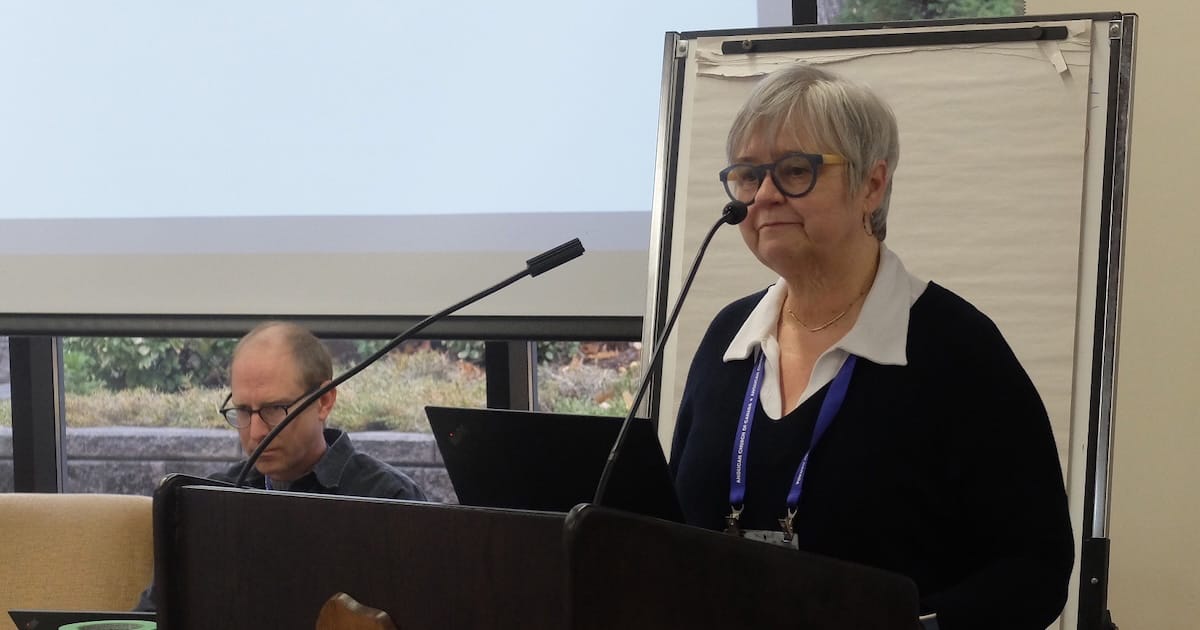
The Transformation Task Force is moving forward in its work to implement six pathways for change in the Anglican Church of Canada identified by a primatial commission, which the General Synod voted last year to advance in the 2025-2028 triennium.
“Each of the pathways is in motion,” Canon (lay) Janet Marshall, co-chair of the Transformation Task Force and director of congregational development for the Anglican diocese of Toronto, said in a May 4 update.
The pathways seek to transform the Anglican Church of Canada in six areas: organizational structure, management overview and restructuring, inclusivity and diversity in decision-making, communications, walking in partnership with the Indigenous church and ministry in remote northern communities.
Marshall said the task force is well into what she calls “phase one” of its work, with its 18 members meeting regularly over Zoom. The first phase involved assessing the current situation in each pathway for change and forming teams that drew up work plans to carry out their mandates.
“We’re now seeing phase two beginning to take shape,” Marshall said. “That for the most part is showing us all the different ways that the pathways are going to intersect and inform each other.”
What a third phase might look like could begin to emerge at the end of 2026 or start of 2027, Marshall said, as the task force determines what it will be able to bring to General Synod in 2028 to take the work of transforming the church into the next triennium.
Marshall and co-chair Andrew Stephens-Rennie, former member of the Council of the General Synod (CoGS) for the ecclesiastical province of British Columbia and Yukon, will present an update on the Transformation Task Force at the next meeting of CoGS on June 11-14. Stephens-Rennie said the role of CoGS is ultimately one of discernment: “Does this work help us to get to where we’ve said we need to go?”
Guided by CoGS, the task force plans to hold its first in-person meeting in November, which will further explore connections between work on each of the different pathways.
Underscoring the scope of their work, Marshall said task force members are all “skilled and gifted people … Every one of them has had experience leading change in the church or in their other professional or volunteer capacity. But I don’t think any of us has had the experience of leading change on this scale.”
While still in its early days, the task force has begun preliminary work on each of the pathways. The Pathway 1 team, focused on the overall shape and governance of the Anglican Church of Canada’s national, provincial and diocesan structures, held consultations at the most recent meeting of the national House of Bishops in April and is now studying the bishops’ feedback, Stephens-Rennie said.
The Pathway 2 team, he said, is focused on identifying opportunities related to Church House, the national office of the General Synod, and how it is managed and structured to serve the church. A key question, Stephens-Rennie said, is, “How are we ensuring that there are clear, transparent and manageable expectations” as roles, relationships and structures are redefined.
To advance the goal of inclusivity and diversity in decision-making, Marshall said, the Pathway 3 team has put out a request for proposals seeking a consultant who can help them identify approaches that already exist, the current situation within the church and the best ways to move forward.
The Pathway 4 team is focused on communication and includes members of the communications committee of CoGS. Its proposals will be brought to CoGS for consideration, Marshall said. “I think we need to wait until CoGS considers and speaks before we say too much more about that.”
Pathway 5 involves partnership between the historic non-Indigenous and Indigenous churches within the Anglican Church of Canada, and Pathway 6 involves northern ministry. These are examples of pathways that are closely tied together, the co-chairs said. As a result, these two teams are focused on relational aspects of this work, Marshall said, listening to discernment and reflections from those most directly involved such as the Anglican Council of Indigenous Peoples and the Council of the North.
Each pathway team is using lists of questions to plan outcomes and goals, what success might look like at different stages, and how to communicate this work to build understanding and support, Marshall said. The task force will soon make these research tools available on the Anglican Church of Canada website.
“Change is happening all over the church,” she said. “It’s not just the Transformation Task Force and the pathways at the national level, but parishes, dioceses and [ecclesiastical] provinces.
“We’re all looking at how to make changes so that we can have healthy structures and systems that will allow us to share the gospel more easily and readily. If we’re finding tools that are helping us plan and lead this change, then we want to share them.”
Members of the Transformation Task Force include Marshall, Stephens-Rennie, the Rev. Jasmine Chandra, the Rev. Canon Patricia Dorland, the Ven. Travis Enright, the Rt. Rev. Anna Greenwood-Lee, Jane Hope, the Rev. Canon Sarah Kathleen Johnson, the Rt. Rev. Naboth Manzongo, Ms. Danica Meredith, the Very Rev. Douglas Michael, Angela Morgan, the Rt. Rev. Rachael Parker, Dorothy Patterson, the Rev. Canon Jenny Replogle, the Rev. Vincent Solomon, the Rev. Kyle Wagner and the Ven. Rhonda Waters.